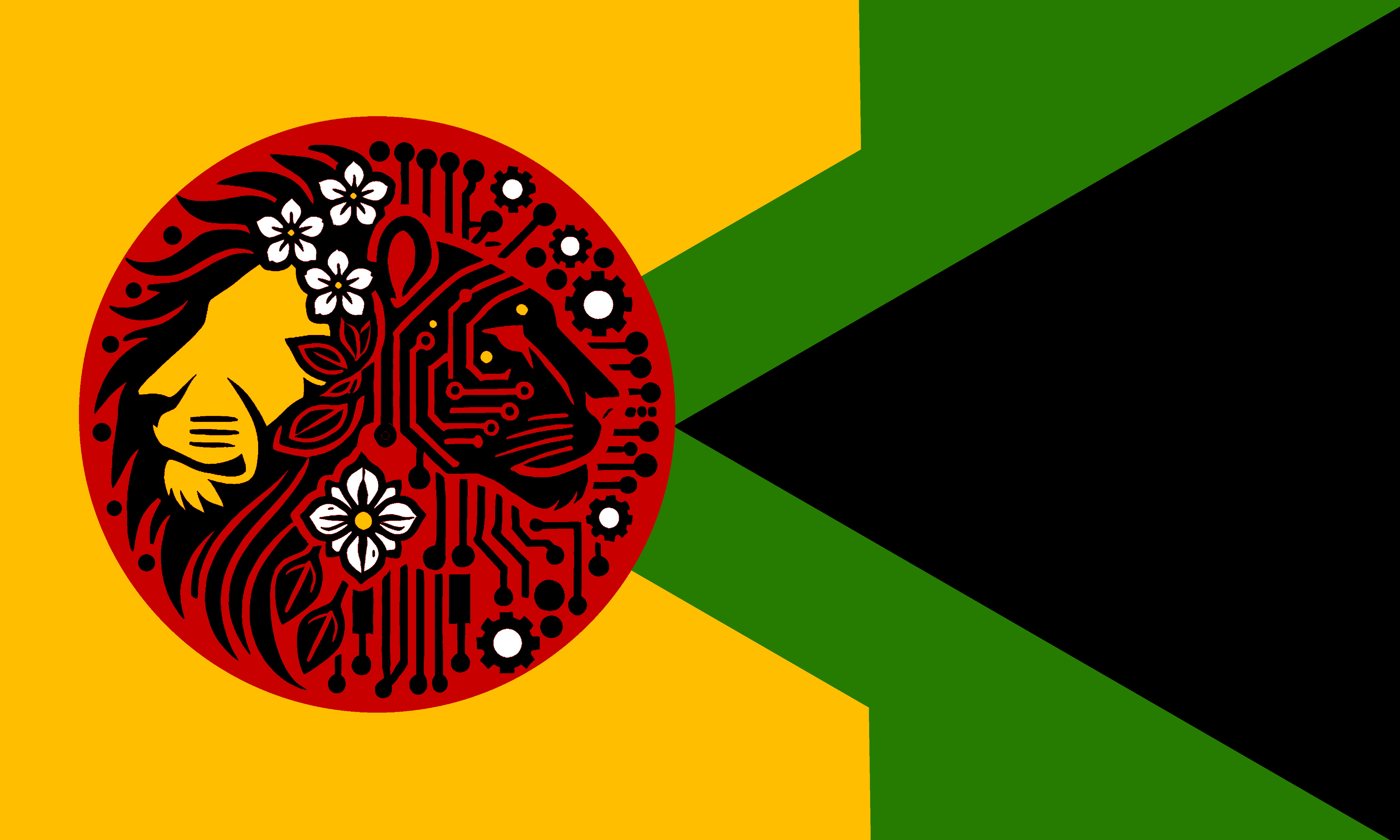
The Afri-Zen Synthocracy is one of the Great Maerthian Three, standing alongside 4th Republic of Erica and the Império de Tarsis as one of the dominant powers on Maerth. The Synthocracy is a highly mechanized, semi-socialist state where human life and cybernetic augmentation are deeply intertwined. Its philosophy champions the integration of humanity and machine, guided by a belief that technological advancement is the only path to survival and prosperity.

The Synthocracy is renowned for its advanced robotics, cybernetic research, and contributions to the defense of human space and morals. It balances this with a strong communal culture rooted in its early history as a mining workforce. Despite its cutting-edge technology, the benefits of its mechanization are unevenly distributed, with the elite enjoying a near-utopian lifestyle while many citizens endure harsh conditions in industrial and mining colonies.

Kanka is built by just the two of us. Support our quest and enjoy an ad-free experience for less than the cost of a fancy coffee. Become a member.

Symbology

The National Flag

9db3d3e4-f5b7-44b3-8e9f-d176dce1e1a8.png

Description:

Lion and Tiger:

  • Lion (blind, looking back): Represents African traditions, cultural heritage, and the wisdom of the past. Its blindness implies reliance on memory, history, and instinct rather than direct sight—symbolizing reverence for tradition.
  • Tiger (cybernetic, looking forward): Represents Asian influence, technological innovation, and forward-thinking ambition. The cybernetic enhancements and open eyes suggest clarity, precision, and adaptation to the future.

Flowers (4):

  • Symbolize the four settled planets under the Afri-Zen Synthocracy, including Maerth and Haedara.

Small Black dots and Gears:

  • Represent major orbital stations and asteroid colonies. Their interconnected placement a highlights the unity between planetary and orbital communities.

Red Circle:

  • A symbol for Maerth and the Soul sun, the Synthocracy’s homeworld and their shared heritage with all of humanity.

Colors

  • Yellow (Background): Symbolize industry, energy, prosperity and abundance.
  • Green (Division): It is inspired by a old mining claw, it signify the Synthocracy's history of asteroid and resource mining, something vital to its foundation. Its colour also represent growth, harmony, health and the environmental stewardship.
  • Black (Triangle): Represents the vast unknown future and space, and the challenges of navigating both. Its color also symbolize resilience, determination, and the acceptance of human struggles.
  • Red (Circle): Red ties to both Maerth and the Soul and their shared human heritage. It also symbolize strength, passion, and the sacrifice of blood made to build the Synthocracy.
  • White (Flowers): Represents purity, hope, and the unification of diverse peoples and traditions. The flowers’ placement emphasizes the balance and care given to the Synthocracy's planets.


National Anthem: 

https://suno.com/song/832c4c28-9ca1-4fa6-beb2-fc63ea212194 

Govurment

The Synthocracy's Politics and Govurment operates under a unique version of communal governance, blending democratic and technocratic elements:


Communal Council:

The ruling body is the Communal Council, composed of elected representatives from Maerth and its colonies. This council oversees policy and ensures that decisions benefit the collective, prioritizing technological development, community and progress.


House of Unions:

A secondary legislative body, the House of Unions, acts as a colonial senate. It represents the interests of individual colonies, ensuring their voices are heard in the Synthocracy’s broader agenda.


Bound Rogue AI, the Èm0-Insimbi :

A relic of the 180s AI Uprising, Èmó-Insimbi is a rogue AI that was captured and bound by the Synthocracy. Despite its malignant nature, it now serves as an advisor to the Communal Council, analyzing data and proposing solutions to complex problems. Its containment ensures it cannot act independently, but its twisted logic often provides innovative—if unsettling—insights.

History

The Synthocracy traces its origins to the first wave of humanity’s off-world laborers many of whom hailed from impoverished regions of Africa and Asia. These workers were sent to the Martian moons and asteroid belts as cheap labor either by their own countries or from other powers. They mined resources critical for Earth’s early space expansion. Over time, these communities developed a unique identity, blending cultural resilience with technological ingenuity and improvisation.

During the 180s Uprising the Synthocracy's forerunners played a decisive role. The moon and asteroid-based miners, who where equipped with primitive but advanced robotics was turned into a improvised defense force, who helped repel the rogue AI forces. Their success won them significant influence in the post-conflict reorganization, including gaining land on Maerth and expanded access to resources.

By the time Maerthian society solidified into the Great Maerthian Three, the Synthocracy had become a leading technological and military power, with its roots in the communal principles of its early pioneers.

Territory

The Synthocracy’s territory spans multiple strategic and historical locations:


In the Soul-system

MaerthIts capital, Zin-Ithemba, it is located in Maerth’s southern hemisphere, nestled in a lush, equatorial zone. The city is a shining symbol of their technological prowess, with towering spires of concrete, glass and metal interconnected by drones, automated monorails, and suspended gardens and farms.

PhobosThe Synthocracy controls a quarter of the Martian moon Phobos, which serves as the base for its navy and as the headquarters of the United Human Defence Board (UHDB)'s Maerthian fleets. The remainder of the moon is shared with other Maerthian powers.

DeimosDeimos is regarded as the Synthocracy’s spiritual homeland. It is where many of the first miners from Earthlargely laborers from Asia and Africa carved out a precarious existence. It remains a cultural and symbolic stronghold, with ancient foundries, monuments and sanctuaries honouring their early pioneers.


Haedara:

The Synthocracy also controls the planet Haedara, acquired during the 180s Uprising. Once a contested battleground, it now serves as a key colony and a center for its agricultural and resource production.

Society and Culture

The Synthocracy is defined by its humble roots and its fusion of man and machine, with a strong emphasis on communal well-being and technological advancement.


Cyborgs and Humanity:

Cyborgs play an integral role in society, often comprising the elite and professional classes. The Synthocracy celebrates their existence as a symbol of human evolution, though baseline humans also make up a large part of the population. Despite this, cyborg citizens are often stratified by their level of augmentation, with the wealthy receiving state-of-the-art enhancements while the poor endure outdated or faulty cybernetics. 

Nutrition Soup is a staple for poorer cyborgs, a holdover from darker times when protein rations—made from biological material donated during augmentation—sustained the population. Although traditionalist cyborgs still consume it, most citizens and those cyborgs able to eat normal foods,  prefer imported exotic foods and traditional spicy foods, which are highly coveted luxuries.


Colonial Life:

Life in the Synthocracy’s colonies varies. While industrial centres such as Phobos are highly mechanized and efficient, agricultural colonies like Haedara retain a degree of humanity and tradition, despite heavy automation. Mining and frontier colonies, however, remain harsh and exploitative, often staffed by indentured workers or second-class cyborg laborers.


Economy

The Synthocracy’s economy is cantered around its vast mechanization, mining, and manufacturing capabilities.

  • Exports: The Synthocracy supplies raw materials, advanced robotics, and cybernetics to most of Human Space. Its cybernetics technology is widely regarded as among the best and most compatible to humans compared to alien options.
  • Imports: It relies heavily on imports of food, luxury goods, and artistic creations. Exotic foods are particularly sought after by its human population, while its cyborg citizens primarily enjoy foreign media and their third party parts.

Despite its wealth, inequality persists. The elite enjoy utopian lifestyles, while the lower classes endure gruelling conditions in industrial zones and colonies.

Military Doctrine

The Synthocracy boasts a small but elite military, specializing in advanced robotics and cybernetic warfare.


Ground Forces:

  • Walking Cyborg Tanks: The Synthocracy fields heavily armored cyborg tanks, controlled by the brains of predator animals such as big cats, dogs or wolves. These cybernetic creatures have superior reflexes and aggression, and are trained and overseen by a central human commander who might even have raised the organic parts from young.
  • Augmented Troops: Traditional human soldiers with cybernetic enhancements support the tanks along with smaller arial drones in combined arms formation, offering flexibility and adaptability in combat of slightly better quality than competing human forces.

Space Fleets:

The Synthocracy’s fleet relies on twinned control ships, where human officers direct fleets of drone vessels. This system allows for efficient coordination but creates a critical vulnerability: if the command ships are destroyed, the drones become inoperative.


The reliance on centralized human control makes the Synthocracy various fighting formations vulnerable to decapitation strikes. Enemy forces targeting command ships or leadership could cripple its military operations by removing the central human command structure from their drone based forces, this strategy is something the Sythocracy is well aware of and use it often to bait enemies into various traps.