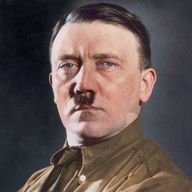
(1889 - 1945)
Adolf Hitler was a German politician, ideologue, and leader of the Nationalsozialistische Deutsche Arbeiterpartei (NSDAP). Though never a part of the Imperial court or cabinet, he wielded enormous power as the de facto ruler of Bavaria and, through the Schutzstaffel (SS), a major influence on German military and political life before and during World War II. His radical doctrines of racial struggle and national rebirth shaped the SS' armed wing, the Waffen SS, into both a mass militia and a genocidal instrument. Hitler’s conspiracy to overthrow Kaiser Willhelm III's government was discovered in 1944 and resulted in a violent crackdown by the Imperial government, culminating in the collapse of the NSDAP and his own suicide.
Born in Braunau am Inn, Austria, in 1889, Hitler served as a soldier in World War I and settled in Munich after Germany’s defeat. He joined the right-wing Deutsche Arbeiterpartei (German Workers’ Party) in 1919, which he transformed into the NSDAP, colloquially known as the Nazi Party. His role in the failed Beer Hall Putsch of 1923, inspired by Mussolini's March on Rome led to imprisonment, during which he wrote Mein Kampf, a book detailing his political theory, primarily that the western world's attempt at destroying Germany, the Velvet Revolution and the October Revolution had all been orchestrated by an international Jewish cabal with the express purpose of destroying Europe and the Aryan race. In the climate of political extremism that developed within Germany, nazi ideas flourished, but were not geographically dominant anywhere except in Bavaria. They were also disproportionately influential on the upper class, including a number of German industrialists and generals, though discreetly so.
The NSDAP’s fortunes improved in the late 1920s with tacit support from Kaiser Willhelm II, who saw the party as a useful counterweight against socialism and republicanism, besides agreeing with their racial theory. In 1928, the NSDAP consolidated power in Bavaria, where it became the dominant political force, establishing a majority government that would persevere until 1944. This position allowed Hitler to shape Bavaria into a testing ground for his totalitarian and revanchist programme. One of the first actions of this new NSDAP government was to establish a number of state-run industries legally owned by the Bavarian crown but really staffed and managed by the NSDAP. Surprisingly enough, Bavaria weathered the Great Depression better than other realms in Germany, further boosting the NSDAP's popularity.
Central to Hitler’s consolidation of power was his alliance with Heinrich Himmler, whose Schutzstaffel (SS) was entrusted with the NSDAP's most delicate matters, including the Gestapo (a brutal internal security service that planned and executed a greal deal of clandestine operations within Germany to further the nazi agenda), the Ahnenerbe (an evolution of the Thule Society devoted to esoteric studies, archaeology and later a top-secret psionics program) and the SS-Verfügungstruppe (later renamed Waffen SS, a volunteer militia or freikorps that operated more as a professional private army). The latter was particularly important as, by the breakout of World War II, it was staffed by over half a million zealous Germans.
When World War II began, the Waffen SS filled critical manpower gaps in the Deutsches Heer and practically held the Alpine Front on its own at the outbreak of hostilities. Their effectiveness on the battlefield was matched by their brutality in occupied territories. Under Hitler’s guidance, the SS initiated Intelligenzaktion operations in France, the Soviet Union, and even within Germany, liquidating suspected political opponents under the cover of anti-communist action, primarily by means of the Gestapo.
On the 9th of July 1941, the German General Staff, deeply infiltrated by the NSDAP at this point, issued Directive K7, authorising the SS to form Einsatzgruppen units as rear-area security forces. These groups conducted mass killings of Jews, Romani, Slavs, and other groups branded as “subhuman“, always justified as anti-partisan operations. The death toll of this years-long massacre is estimated at 1.5 million and was carried out using a diverse set of methods, some more creative than others, including firing squads, mass immolation, gas vans, forced marches and industrial slavery, the latter consisting of transporting "prisoners of war" specially marked by the Einsatzgruppen into Bavaria to be used as slave labour in "labour camps", often working them to death. This dreadful campaign was known post-war as the Holocaust. Hitler privately commented to his inner circle that such actions were necessary for the racial regeneration of Europe. Though reports of these atrocities reached Berlin, Wilhelm II suppressed them and left standing orders not to report them to his government anymore. With Wilhelm II’s death in 1943 and the accession of Wilhelm III, scrutiny of Hitler’s methods increased sharply.
Wilhelm III viewed Hitler and the NSDAP as a threat to imperial stability. From late 1943 onward, the Kaiser and his Abwehr gradually undermined the NSDAP, while even Leon Trotsky privately acknowledged the distinction between German imperial policy and the Nazis' covert racial war. An informal understanding was reached between Berlin and Moscow through secret correspondence: the NSDAP had to be dismantled for the survival of all.
In 1944, the Ahnenerbe successfully discovered the basic principles of psionics and sorcery, attributing it to a mythical force they named Vril. This was only possible by the arrival of pro-Nazi Oceanykans knowledgeable in such matters, thanks to the Schutzstaffel (SS)'s successful esoteric expedition into Oceanyka years prior. Offensive sorcery began to be employed in the Eastern Front, alarming both the German and Soviet High Commands, who suppressed all information pertaining to the use of such means in both sides of the frontline. In July of that year, evidence of Hitler’s preparations for a coup reached Wilhelm III, prompting the launch of the Kaisersuntersuchung, or the Imperial Inquiry. The Abwehr began dismantling NSDAP influence in the military, while Operation Valkyrie was planned to destroy the party entirely. All of the Waffen SS was brought back to Bavaria for garrison duty, many of its divisions were forcefully disbanded (ostensibly to use its manpower in other "more important" duties) and the Einsatzgruppen program was scrapped.
By late 1944, Hitler understood that the NSDAP's time was running short, and the Kaiser's pressure became stronger. Facing a number of impending trials and, in all likelihood, the imminent disbanding of his movement, he ordered loyal divisions to revolt, thus beginning the National Socialist Uprising. The Kaiser's government responded by executing Operation Valkyrie, known by the press as the Kaisersäuberung or the Imperial Purge. Bavaria and parts of southern Germany descended into civil war. Waffen SS troops fought the Allied Nations, who had prepared for this eventuality for months, throughout the winter of 1944-1945. Concurrently, the Ahnenerbe was opposed by a special Allied task force specially organised to counter their sorcerous means, Task Force THAUMIEL, consisting of a hodgepodge of elite Allied soldiers, including a great deal of Oceanykan Secret Society Trackers. On the 3rd of February 1945, with Munich encircled and his authority disintegrating, Hitler shot himself in his bunker. Unlike Himmler and other SS leaders, who fled to the Congo through clandestine routes, Hitler did not escape. His body was recovered by imperial troops.
Adolf Hitler’s life remains a study in fanaticism and political extremism. His doctrines radicalised a great deal of the German population, turned parts of the state apparatus into a genocidal machine, brought Bavaria to ruin, and destabilised the Kaiserreich in its hour of need, allowing the Soviet Red Army to carry out offensive operations in the Eastern Front with greater ease. Though his attempted coup failed, the legacy of the Nazis remains a black stain in Germany's history, and informed the world's leaders of the existential danger that Anomalous ❓ phenomena could present.