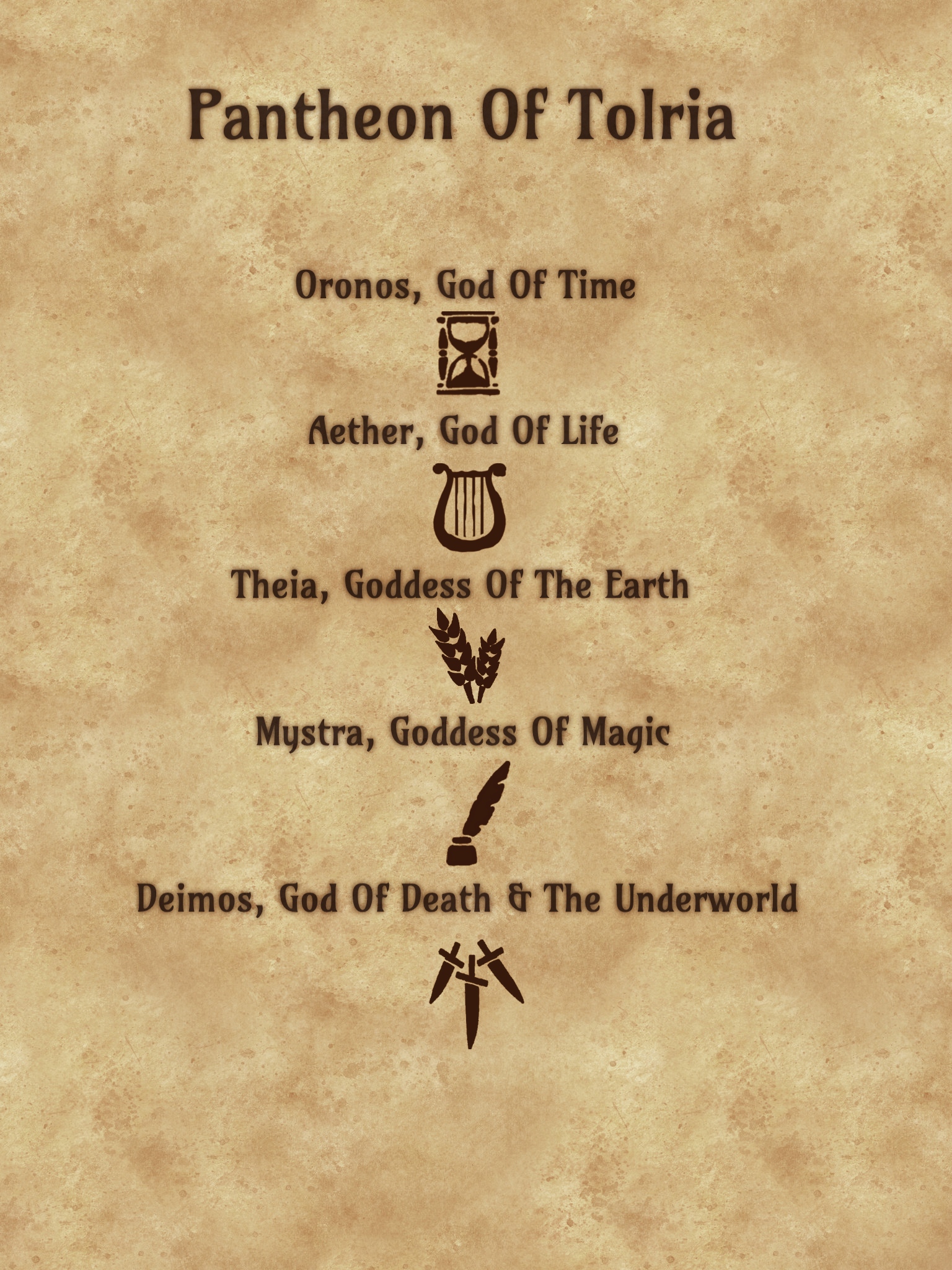
The Pantheon of Tolria is a mortal construct representing the most widely worshipped deities across the continent of Tolria. Unlike the true Pantheon of Primus, which governs the cosmic order across all realms, the Pantheon of Tolria reflects the cultural and religious practices specific to Tolrian societies. It is a collection of divine entities, each with unique portfolios of power, revered for their influence over aspects of life, death, magic, and the natural world within the material plane.
The deities in this pantheon are worshipped by countless mortals across the land, though their interpretation and reverence may vary between regions. While the gods represented in Tolria's pantheon have roots in the true divine hierarchy of the cosmos, this pantheon is more of a reflection of mortal belief than an accurate portrayal of the cosmic order.
The Pantheon’s Composition
The Pantheon of Tolria consists of five major deities, each representing a fundamental force or domain central to life on the continent:
- Oronos, God of Time
Oronos governs the flow of time and the continuum of past, present, and future. His influence is felt in the cycles of seasons, the march of history, and the inevitability of fate. Worshippers of Oronos include scholars, historians, and those who seek to understand or alter the course of time. He is often portrayed as a solemn figure, with an hourglass held in one hand and a scales in the other, symbolizing both the gift and burden of time. - Helios, God of Life
As the radiant bringer of life, Helios is the source of vitality for all living things. He is often associated with the sun and light, which nurture growth and sustain life across Tolria. Helios is revered by farmers, healers, and anyone seeking blessings for health and fertility. His followers see him as the benevolent force that opposes death and destruction, offering hope and renewal. - Theia, Goddess of the Earth
Theia represents the physical world, the earth beneath one’s feet, and the stability that comes with it. As the goddess of earth and substance, she is worshipped by those who rely on the land—farmers, miners, and builders. Theia is often invoked for protection, harvests, and strength. Her temples are commonly found in rural communities where her connection to the land is celebrated through festivals and rites. - Mystera, Goddess of Magic
Mystera presides over the arcane and the mysterious forces of magic that weave through the world. Her domain includes spellcraft, knowledge of the unseen, and the power to bend reality. Mystera’s followers include wizards, sorcerers, and magical scholars who seek to harness and understand the energies that flow from the Weave. Her symbol is often seen in places of learning, where magic is studied and revered. - Deimos, God of Death
Deimos is the inevitable end to life, presiding over death, the afterlife, and the passage from life into the unknown. While feared by many, Deimos is also respected as a necessary force that maintains the balance between life and death. His worshippers include those who care for the dead, such as morticians and priests, as well as those who seek to understand the mysteries of the afterlife. He is often depicted as a robed figure carrying a lantern, guiding souls to their final resting place.
Worship in Tolria
The Pantheon of Tolria is worshipped in grand temples and small shrines alike, with each deity having their own devoted followers who perform rituals, offer sacrifices, and uphold the teachings of their chosen gods. Priests and clerics act as intermediaries between the gods and the people, interpreting signs and blessings while offering counsel to those seeking divine favor. Each city and town typically has a patron deity from the pantheon, depending on its culture, economy, or historical significance.
Mortal Interpretation and Influence
While the Pantheon of Tolria is central to daily life for many on the continent, it does not necessarily reflect the true Pantheon of Primus. Mortals often interpret the gods through their own experiences and needs, sometimes creating myths and legends that only loosely align with the true nature of the deities. The gods themselves rarely interfere with these mortal interpretations, allowing their influence to be felt through clerics, avatars, and divine signs rather than direct intervention.
This pantheon has also shaped the geopolitical landscape of Tolria, with many rulers claiming divine right or favor from the gods. Religious sects and cults have sprung up, each with its own interpretation of the gods' will, further deepening the complexity of the pantheon's worship.
In this way, the Pantheon of Tolria serves as both a spiritual guide and a reflection of mortal desires, fears, and aspirations. The gods, while distant, remain central to the culture, politics, and philosophy of Tolria.