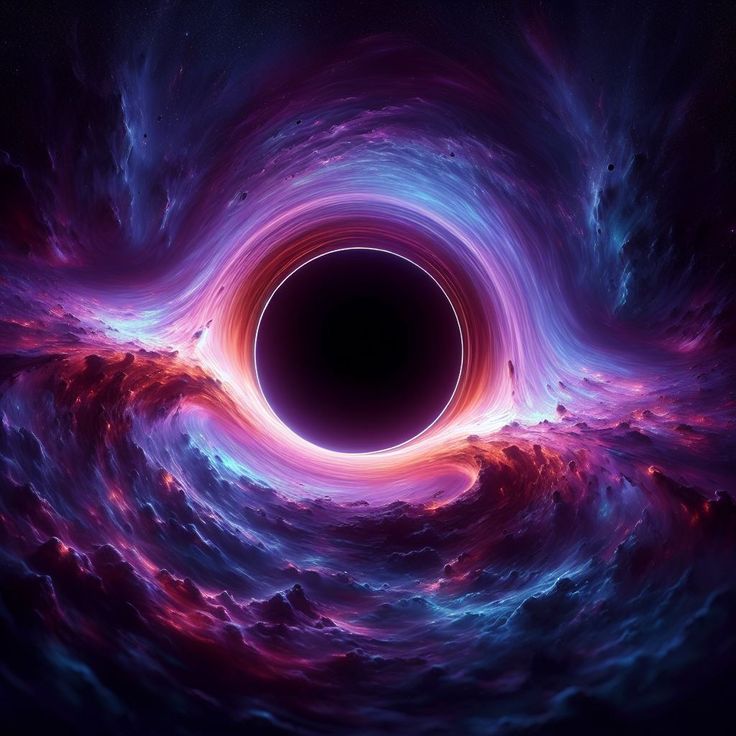
Appearance
Nox, unlike the other Eldari, defies any visual form or divine persona. Nox is the embodiment of Void, the complete absence of matter, time, and existence. It is not depicted as a deity with shape or presence, but as the paradox of non-existence itself. To gaze upon Nox is to confront nothingness—an infinite blackness in which nothing stirs or moves, where light, energy, and life are all swallowed into oblivion.
Whereas the other Eldari represented active forces, from Ael's creation to Ignis' energy, Nox is the passive force that exists as the ultimate end of all things. It does not act, it simply is. An eternal, empty stillness that remains after even the most primordial elements faded.
Origin
Nox was born from the eternal dreams of Azhorra'tha, the Watcher in the Abyss, as a reflection of its subconscious understanding of the end. Where Ael embodied creation and Prism gave shape to chaos, Nox was the final counterbalance—the infinite void that remained after all else was undone. From the moment of its inception, Nox stood apart from the others, its paradoxical existence representing the inevitable conclusion to the cycle of matter and life.
Nox was not a force that acted in the cosmic clash of the Primordial Pandemonium. Instead, it was a quiet presence, awaiting the natural end of all things. Unlike Thanatos, who actively sought to bring about decay and destruction, Nox was indifferent to the very concept of existence. It did not destroy—it simply marked the point at which all destruction would culminate, beyond which nothing could remain.
Existence
Nox’s existence is more of a philosophical paradox than a divine presence. It has no will, no sentience, and no desire—unlike the other Eldari, who sought to shape, break, or control the universe. As the Void, Nox simply is. In a way, Nox is not truly an entity but rather the absence of one. It is what remains when everything else ceases to be. In this way, Nox represents a finality beyond even death, as Thanatos decays matter, and Nox consumes what is left when there is nothing else to destroy.
This lack of sentience is key to understanding Nox. The Eldari like Ael, Prism, and Ignis all had roles to play in shaping the Continuum Crystal Cosmology, but Nox’s role was passive and inevitable. It did not seek to bring about the end of things—it simply waited for that end to come naturally. As matter and energy dissipate, as stars collapse and light fades, Nox waits to claim the remnants, until only nothingness remains.
Powers and Abilities
Nox is the ultimate embodiment of anti-matter and void, though it holds no conscious power over the cosmos. Rather than influencing the universe with active abilities, Nox represents the absence of such power. It is a force that passively consumes everything. Stars collapse into black holes, matter decays to nothingness, and when all that can be destroyed has been consumed, only Nox remains.
- Void Consumption: Nox embodies the end of all things. Though not actively destructive, it passively represents the inevitable end of matter, light, and life. As black holes devour stars, their remnants are lost to the void that Nox represents.
- Anti-Matter Paradox: Nox embodies the void between stars, realms, and planes. It is the infinite emptiness that defines the boundaries of existence.
- The End of Time: Nox represents a future where all things come to an end, even the gods, as it awaits the collapse of time itself.
Connections
Nox’s closest relationship is with Thanatos, the Eldari of Decay and Destruction. Thanatos represented the process of decay and the disintegration of matter, while Nox is the final outcome—the state after all matter and energy have been consumed. Together, they represented a duality in the cosmos, where Thanatos destroys, and Nox claims the void that remains.
Azhorra’tha, the dreaming god, is also deeply tied to Nox. As Azhorra’tha fell deeper into madness, its dreaming mind created the Void of Infinitum, a realm of endless descent where Nox reigns in the form of the Void itself. This abyss is the final frontier of creation, where the dreams of gods and the lives of mortals fade into the emptiness of nothing.
Nox is also a natural counterpart to Ael, who embodied creation and life. For every birth, there is an eventual death, and beyond that, there is Nox—the absence into which all creation will eventually dissolve. In the same way, Nox also defines the end of Ignis (energy), Gaian (matter), and Zephyr (space), as even these fundamental elements cannot escape the void.
Legacy and Legends
Despite having no true will or consciousness, Nox’s legacy is one of inescapable finality. It is feared by mortals and gods alike as the inevitable end of all things. Many mythologies speak of the time when even the gods will fade, and Nox will claim the universe in an eternal blackness. For some, Nox represents the ultimate peace, the final rest after the chaos of existence, while for others, it is the most terrifying fate of all.
Nox is worshipped in some dark cults, particularly among those who seek to hasten the end of existence. However, these followers often misinterpret the nature of Nox, viewing it as an active force rather than the passive inevitability it truly represents.
The most prominent manifestation of Nox’s influence is the Void of Infinitum - contained within The Continuum Crystal - a realm that embodies the infinite layers of the abyss, where even the mind of Azhorra’tha falls into oblivion. This place is the prison of the Watcher in the Abyss, who is trapped within his own dreams, descending further into madness as he delves into the layers of void.
End of All Things
Nox does not die because Nox never truly lived. It is not an entity that can be destroyed, as it is the absence of existence itself. When the universe reaches its end, when the stars burn out and all matter decays, it will be Nox that remains, for nothingness is eternal. Even the gods must succumb to its pull, for in the end, there is only void.
In the cosmic balance, Nox represents the quiet acceptance of entropy. There is no final battle for Nox, no heroic struggle to survive. There is only stillness, waiting, and the inevitable conclusion when all things return to the nothingness from which they came.