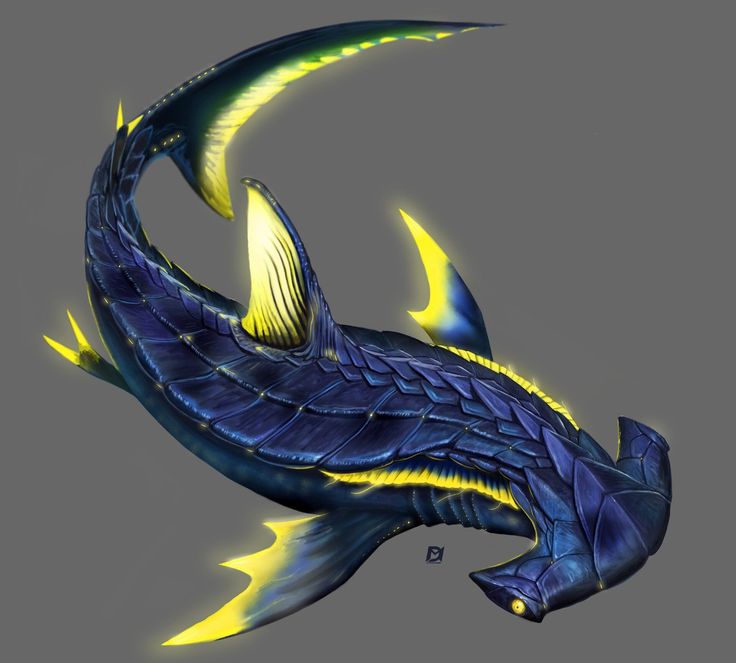
Void Sharks (Sphyrnidae umbraxis) are apex interstellar predators adapted to the vacuum of space. They are most commonly encountered near active stars and nebular regions where Sun Fish schools congregate. Void Sharks are highly aggressive, territorially dominant, and capable of coordinated pack behavior, making them one of the most dangerous semi-sentient lifeforms encountered along major transit routes.
Although originally non-hostile toward spacecraft, recent behavioral shifts have increased their threat profile significantly.
Origins & History
Void Sharks are believed to share a common evolutionary origin with Sun Fish, having diverged from a planetary biosphere that experienced progressive atmospheric loss and gravitational instability. While Sun Fish adapted toward passive radiation harvesting and communal migration, Void Sharks evolved as specialized predators within the same collapsing ecosystem.
On their origin world, Void Sharks developed hardened cranial and dorsal structures to ram seaside caves, reef walls, and coral formations, flushing out Sun Fish schools that sought shelter in dense terrain. As the species transitioned fully into space, these behaviors persisted.
In recent centuries, Void Sharks have begun exhibiting ship-targeting behavior. This is widely believed to be a learned adaptation resulting from repeated encounters with wreckage in Echelon-controlled space, where overfishing of Sun Fish led sharks to scavenge damaged vessels. Survivors were identified as viable prey, reinforcing ramming and hull-breaching behaviors.
Physical Traits
Sphyrnidae umbraxis possess elongated, muscular bodies encased in a reinforced exoskeletal dermis composed of layered, mineralized plates. This armor allows high-velocity impact without lethal trauma, enabling repeated ramming attacks.
Their defining hammerhead morphology is significantly expanded relative to planetary analogues. The lateral extensions house dense arrays of electromagnetic and radiation-sensitive organs, allowing Void Sharks to detect Sun Fish schools across stellar distances by tracking photonic emissions and energy gradients.
These same organs enable detection of starcraft power signatures, making powered vessels particularly visible targets. Bioluminescent yellow fins serve both as intraspecies signaling structures and as lures during predation events.
Society and Culture
Void Sharks are semi-social predators. They most commonly hunt in pairs or small packs, coordinating attacks through rapid directional signaling and electromagnetic pulses.
While not sentient, they demonstrate advanced learned behavior and environmental adaptation. Rare instances of semi-symbiotic arrangements have been observed between Void Sharks and pirate crews, wherein sharks are guided toward Sun Fish schools in exchange for unimpeded access to prey. These relationships are unstable and frequently end in loss of life.
Void Sharks do not always form long-term territorial claims but will repeatedly return to productive hunting corridors.
Legacy
Void Sharks are classified as controlled megafauna threats by most interstellar authorities. Regulated hunting is permitted within multiple jurisdictions to maintain ecological balance and protect shipping lanes. Any Void Shark that attacks a starcraft is designated immediate reprisal eligible, and coordinated hunts are often authorized following such incidents.
Despite these measures, populations remain resilient due to slow but stable reproduction and wide migratory ranges.
Void Sharks represent a rare case of non-sentient life adapting predator behavior in response to industrial exploitation by sapient species. Their increasing interaction with starcraft serves as an indicator of broader ecological disruption in heavily trafficked stellar regions.
They are not malicious—but they are no longer ignorant of what flies among the stars.