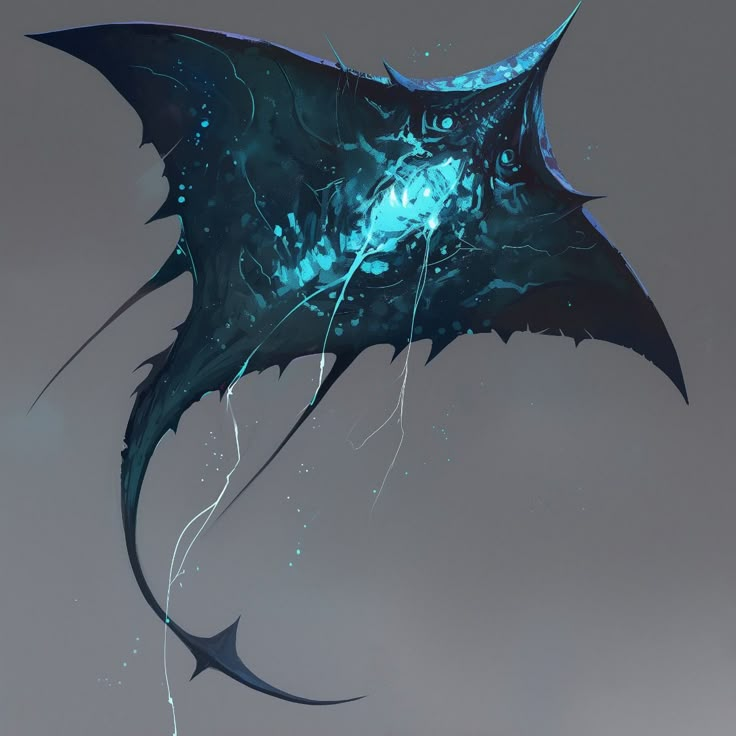
The Ion Rays (Mobula stellaris) are large vacuum-adapted megafauna resembling manta rays, native to nebular and ion-rich stellar regions. They are distinguished by their dark purple to black dermal plating, trailing ionized vapor wisps, and elongated, energy-charged tails. Ion Rays travel in small migratory groups known as squadrons, typically numbering between five and ten individuals.
Although generally non-aggressive, Ion Rays possess defensive capabilities capable of disabling spacecraft or paralyzing large organisms, making close encounters hazardous.
Origins & History
The origin of Mobula stellaris remains unknown. No planetary evolutionary chain has been identified, and no fossil analogues have been discovered. Their physiological design suggests adaptation directly to vacuum conditions rather than planetary atmospheres.
Several xenobiologists have proposed that Ion Rays may have originated within high-energy nebular formations or potentially from extra-dimensional environments connected to Rift Energy phenomena. No conclusive evidence supports either hypothesis.
Ion Rays once occupied a wide migratory range across multiple nebular corridors. However, intensive poaching—particularly near frontier systems—has drastically reduced their population density. As a result, most surviving squadrons avoid major shipping lanes and colonized star systems.
Physical Traits
Ion Rays possess broad, sail-like bodies with wingspans reaching several kilometers. Their dermal layer is reinforced with dense, mineralized tissue capable of absorbing high-velocity impacts, including small asteroid collisions.
Trailing from the posterior margins of their bodies are persistent wisps of ionized gas, generated through metabolic interaction with charged nebular matter. These wisps aid in maneuverability and may function in squadron-level signaling.
The most distinctive feature is their elongated spiked caudal appendage, which stores accumulated ion energy. Ion Rays metabolize ion-rich gas clouds, converting ambient charge into a biological compound known as Stellaris Serum. This compound can be discharged through the tail as a focused electromagnetic pulse capable of destabilizing electronics or inducing neuromuscular paralysis in biological targets.
This mechanism serves primarily as a deterrent against predators such as Sphyrnidae umbraxis (Void Shark), though it has also resulted in unintended starcraft interference when vessels intrude into migratory paths.
Society and Culture
Ion Rays travel in structured squadrons that exhibit coordinated movement patterns. Squadron members maintain relative formation through low-frequency electromagnetic signaling and ion trail modulation.
They are migratory but follow semi-predictable nebular currents and ion density gradients. Unlike Riftback Whales, Ion Rays avoid dense traffic corridors, a behavior believed to be a learned response to sustained hunting pressure.
There is no evidence of territoriality or tool use. However, squadron coordination suggests distributed awareness and adaptive defensive learning.
Legacy
Ion Rays are classified as a threatened megafauna species within Halcyion-controlled space. Poaching remains illegal across most Federation systems, though black-market demand persists. Their tails and extracted Stellaris Serum are highly valued for use in illicit electromagnetic weapon systems and paralysis agents.
Populations have declined significantly in regions adjacent to unregulated trade corridors. Surviving squadrons have increasingly migrated into remote nebular territories.
Ion Rays remain one of the few known species capable of naturally generating large-scale electromagnetic disruption in vacuum. Their ecological role in nebular ion regulation is not fully understood, and further decline may have broader astrophysical consequences.
Whether native to this dimension or an emergent Rift-adapted organism, Mobula stellaris represents a rare intersection of biological resilience and stellar ecology.