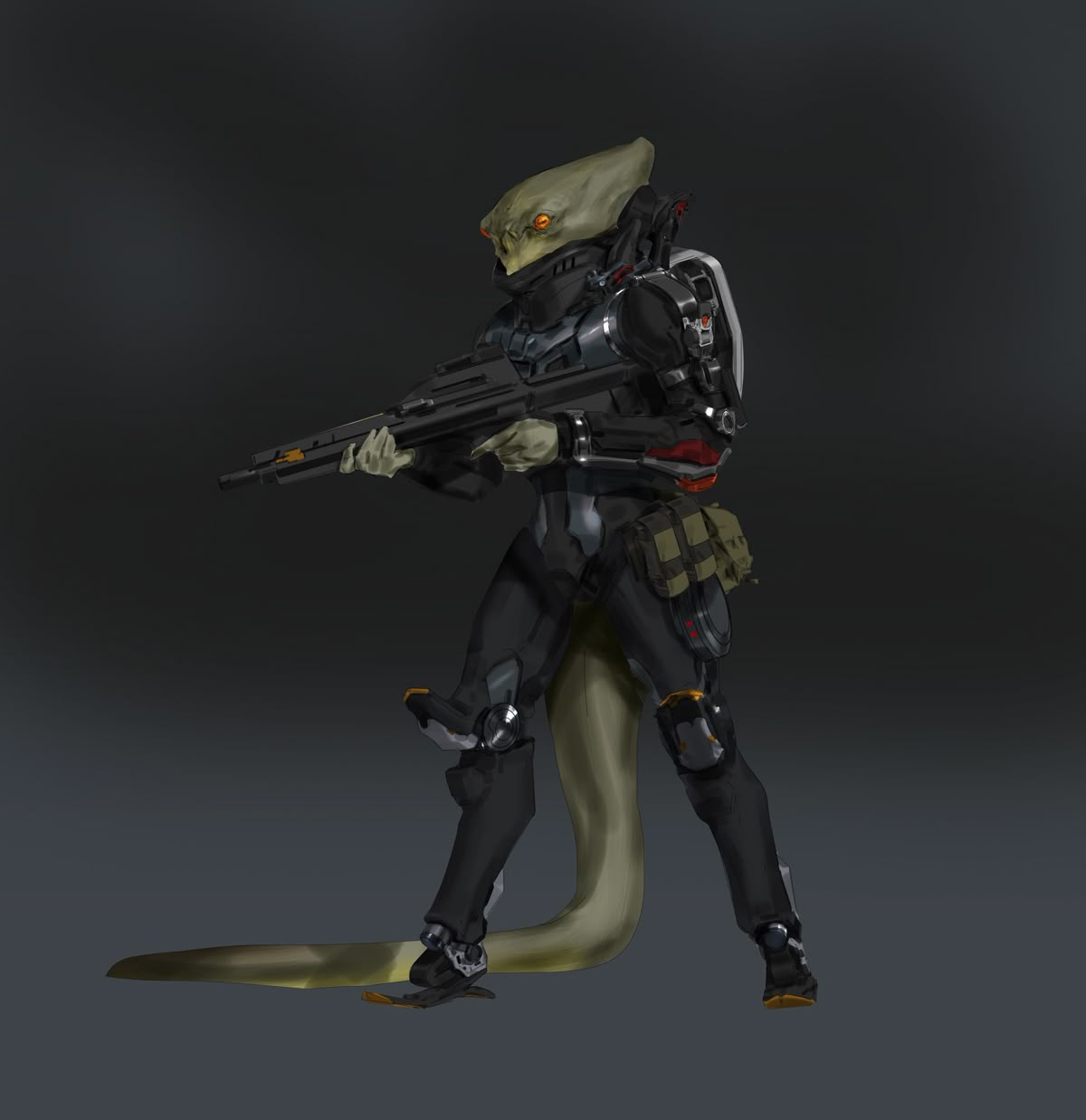
The Keth’rassa are an amphibious Istryxian sub-species native to the swamps, deltas, and coastal shallows of Istryx. Adapted to humid and water-dominant environments, they are biologically closest in form to large salamander-like reptiles, with elongated bodies and moisture-dependent dermal systems.
They are distinguished by their advanced symbiotic practices and their cultivation of crustacean megafauna, making them one of the most ecologically integrated lineages on Istryx.
Origins & History
The Keth’rassa evolved in regions where land and water are inseparable—brackish wetlands, mangrove forests, and coastal archipelagos constantly reshaped by tides and predation. In these environments, survival required adaptability to both submerged and terrestrial conditions.
Early Keth’rassa tribes developed cooperative relationships with large armored crab-like organisms known as Astrachoryx. These creatures serve as mobile fortifications, construction platforms, and aquatic mounts. Over generations, Keth’rassa selective breeding refined these bonds into stable symbiosis.
Unlike the desert and jungle lineages, Keth’rassa expansion was less territorial and more infrastructural. They became builders of marshland colonies and coastal settlements, using living organisms as both material and defense.
Physical Traits
Keth’rassa possess streamlined amphibious bodies with flexible spinal structures and moisture-retentive dermal layers. Their scales are thinner than those of the D'horvakk but reinforced along the spine and shoulders.
Respiration is dual-capable; they can extract oxygen from both air and water, though extended time in arid conditions causes physiological strain. Without environmental support, dehydration impairs mobility and sensory clarity.
In collaboration with the Qy'reen, advanced hydro-suits have been developed to allow Keth’rassa prolonged operation in dry or vacuum environments. These suits regulate moisture, temperature, and pressure while preserving full mobility.
Claws are narrower and more dexterous, optimized for tool use and marine movement. Sensory perception includes enhanced detection of pressure shifts and water vibration patterns.
Society and Culture
Keth’rassa society emphasizes cooperative adaptation. Settlements are semi-organic structures integrated into tidal ecosystems and reinforced with Astrachoryx shells and coral-like growths.
Their relationship with Astrachoryx extends beyond transport and defense. Astrachoryx are used in construction, acting as mobile foundations for marine settlements. Their shells are harvested only upon natural death and incorporated into armor or structural plating.
The Keth’rassa are the primary cultivators of Astrachoryx, massive flying crustacean organisms capable of vacuum survivability. The Keth’rassa maintain controlled breeding colonies, enabling mineral harvesting from floating islands and nearby asteroid belts.
Leadership among the Keth’rassa is determined by ecological stewardship—those who inspire the greatest advancement between tribal accord and environmental terra-forming command authority.
Legacy
Within The Halcyion Federation, the Keth’rassa are valued as engineers of living infrastructure and specialists in aquatic and low-gravity environments. Their Astrachoryx cultivation has become strategically significant for mineral extraction and planetary defense.
Their cooperation with the Qy’reen has strengthened technological exchange, particularly in life-support systems and bio-mechanical integration.
Though less overtly assertive than the D’horvakk or Zaelyth, the Keth’rassa are formidable when defending their territories. Their layered defensive structures and coordinated crustacean formations have repelled both off-world raiders and large-scale predator incursions.
Among the Istryxian, the Keth’rassa represent resilience through integration rather than dominance. Where others carve through the environment, the Keth’rassa endure within it.