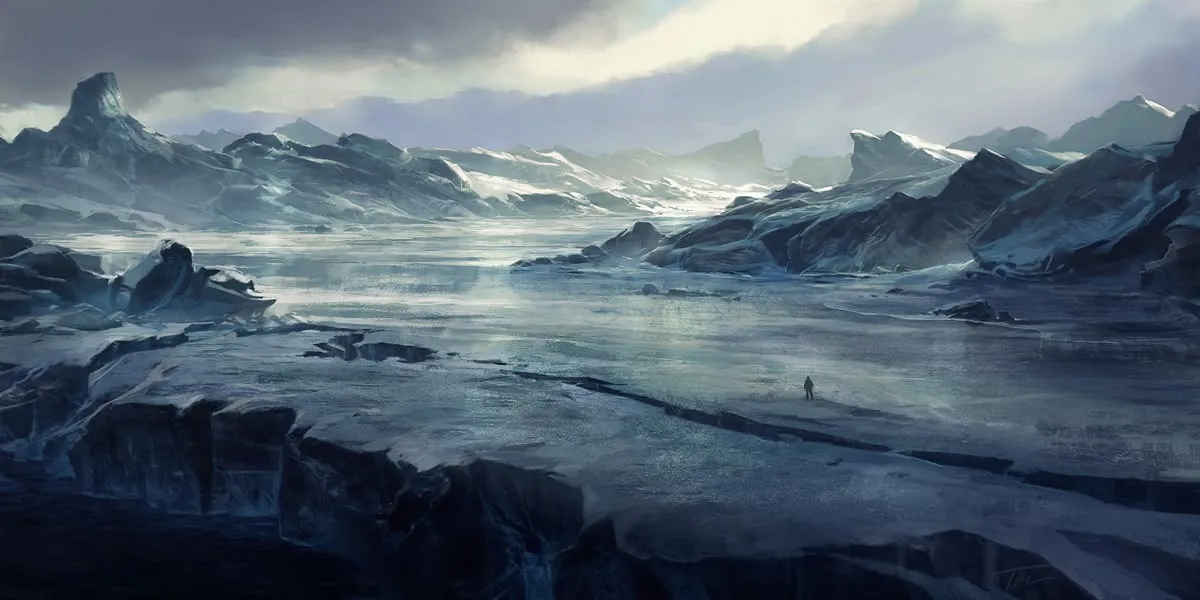
The Everglass lay high in the southeastern Crowncrests, a massive lake held in a broad stone basin beneath constant cold. It stretched for more than fifty miles from west to east; even during the Long Gleam, the air remained sharp, and the surrounding peaks kept warmer winds at bay. From a distance, the lake appeared less like water and more like a single, continuous sheet of stone. At its eastern end, the Everglass terminated at Giantsbane, where the shattered skeleton of an immense giant lay half-embedded in ice and rock.
The Everglass took its name from its permanent ice. Those who dared to cross it reported that the surface never cracked or shifted, regardless of season or weight. Sleds and wagons were said to pass without sound or warning, and no thinning was ever observed. Some scholars argued that the lake must be frozen solid all the way to its bed, despite insisting that such a thing should be impossible given its size and depth.