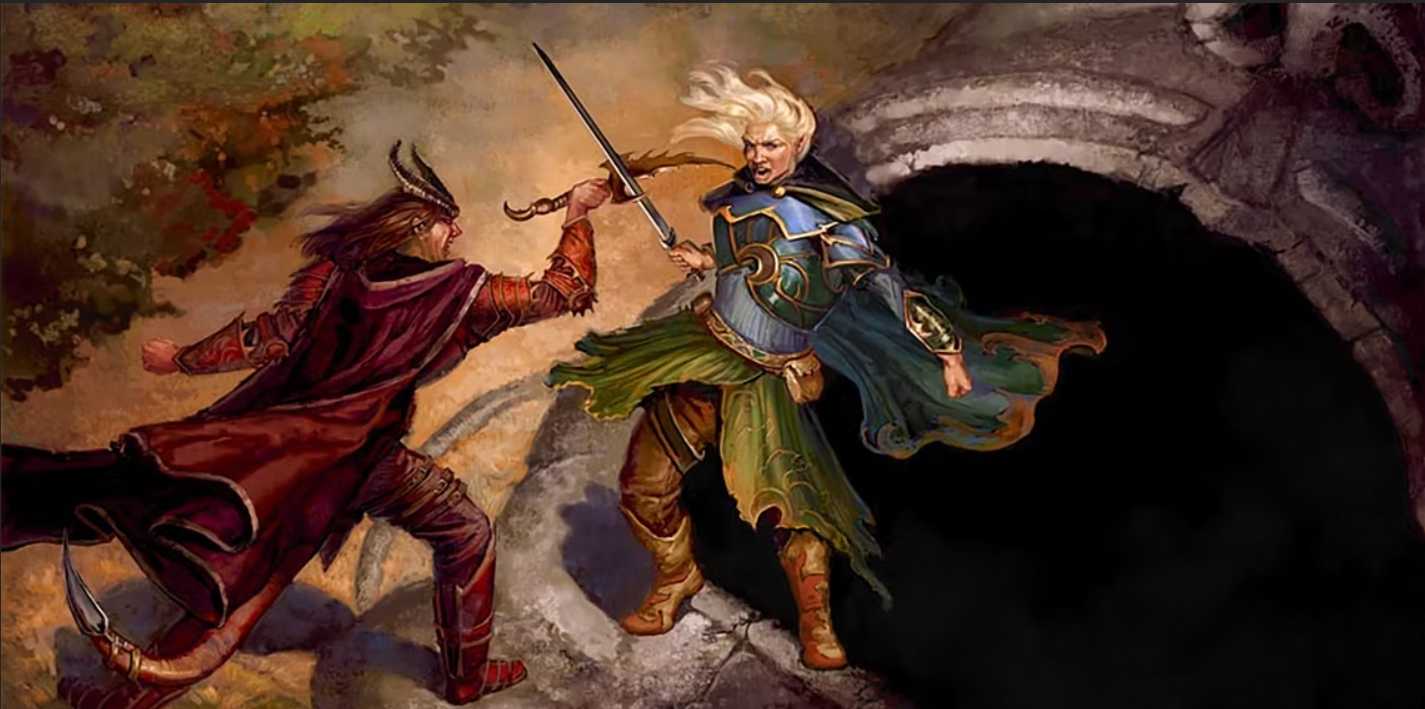
Chrondor has a long history of sanctioned duels. The rules of these duels have also been adopted widely among those sailing the Azhure Sea.

The Dueling code
- Duels occur in public, outside, during daylight hours.
- Each participant fights alone and can receive no help from outside sources.
- Each participant declares a second, who acts as a witness and ensures both participants obey the rules.
- Each participant fights with the same or similar weapons, determined and agreed to by both parties before the duel begins.
- The participants decide between themselves what armor and shields are allowed.
- No magical items or effects can be used before or during the duel to aid its participants. Any participant found benefiting from magic forfeits the duel and is declared dishonorable.
- The duel lasts until one of the participants bleeds, surrenders, or is unable to continue.
Depending on the rules of the duel, the winner can be the first one to score three touches, to the blood, or to the death.
The role of the Second is to:
- Negotiate on behalf of the duelists to set the rules, time, and place of the duel. They could even negotiate peace, avoiding the duel.
- Act as a witness and ensure both participants obey the rules.
- Take the place of an ill, injured, or cowardly duelist.
- Notify the next of kin when death occurs, and tend the body of their fallen comrade.
The Flow of a Duel
1. Intimidation
Begin the duel with an intimidation round to allow either opponent the chance to earn a boon to start the duel.
Each participant in the duel makes their choice of a Charisma (Intimidation) or Charisma (Performance) check, contested by their opponent’s Charisma (Intimidation) or Charisma (Performance) check. Other skills such as Insight or Investigation can also be used if applied creatively.
The winner of the contest gains 1d4 to their first attack roll.
2. First Initiative
After intimidation, both sides roll Initiative.
- If one party rolls above 15, and the other doesn't, they gain Advantage on their first attack.
- If both parties roll above 15, the highest roller gains Advantage on their first attack.
- If neither parties roll above 15, no one gains Advantage.
3. Choosing a tactic
At the start of each round, both sides must choose their tactic for that round; either Push, Parry or Feint. Each chooses secretly and reveals simultaneously, like 'rock-paper-scissors'.
- PARRY BEATS PUSH, as the parrying character turns away the obvious attacks of the push. The character who parried gets +3 AC.
- PUSH BEATS FEINT, as the aggressive push forward batters through the attempts at finesse. The character who pushed does +3 damage if they hit.
- FEINT BEATS PARRY, as the feinting characters create openings to strike past their enemy’s guard. The character who feinted gets +3 to hit.
- IF BOTH SIDES PARRY, then the duel becomes a defensive stand-off. Both characters get +3 AC.
- IF BOTH SIDES PUSH, then they just batter at each other furiously for the round. Both characters do +3 damage if they hit.
- IF BOTH SIDES FEINT, then the duel becomes a complex dance of strikes and counters. Both characters get +3 to hit.
Types of Duels
There are generally 3 types of duels:
- 3 Touches (alternatively, 5 touches): Use the rules as described, but do not use damage rolls. The +3 damage of Push counts as 2 touches.
- To The Blood: Use the rules as described. The first character to reach half HP loses.
- To The Death: Use the rules as described. Whoever goes down, must make their Death Saves unassisted. If they die, they die.
original created by Lars, at Iralas.
Proselytizing
Characters with a religious bent might want to spend downtime specifically recruiting for their faith by proselytizing in the community. Someone who undertakes this activity has a chance of winning convert's that favor either an existing temple, or a temple started by the character.
Resources. Performing religious service generally requires access to a temple whose beliefs and ethos align with the character’s. A travelling character without a temple may speak in public or strike up conversations with like minded folk. The activity takes one workweek of time and can earn donations for the cause (compare roll to the Downtime Activity: Work).
Resolution. At the end of the required time, the character chooses to make either an Intelligence (Religion) check or a Charisma (Persuasion) check. The total of the check determines the benefits of proselytizing, as shown on the Religious Service table.
Religious Service
| Check | Total Result |
| 1–10 | No effect. Your efforts fail to make a lasting impression. |
| 11–20 | You gain one convert. |
| 21+ | You gain two converts. |
The DM may impose modifiers or advantage/disadvantage based on the culture, size, type, etc of the area.
Official Options
Multiclassing As Listed in PH.
Feats As Listed in PH.
More Difficult Magic Item Identification: DMG Link.
2024 Revisions Incorporated/Not
Use 2014 Sleep spell.
Actions
Bonus Action: Drink a potion (administer potion still an action)
Bonus Action: Don a shield.
Variant Rules
New Rest Period: Extended Rest is a week long, used for downtime or slow to recharge abilities/items.
Sorcerers know 2 additional spells above what is listed in the PH chart under spells known, the additional spells must match their theme.
Ranger Favored Enemy: Hunter's Mark (1st level) applies to Favored Enemy for free.
Bladesinging works with Elven chain.
Bladesinging is also a bard subclass.
Add Int (Profession) as an INT based knowledge skill.
Attunement Slots = Proficiency Bonus
Wild Magic rolls 1d20 for surge every non-cantrip spell cast, surges on level of spell or lower. Using Tides of Chaos causes next non-cantrip spell cast to surge, and Tides of Chaos is regained.
Dual Weapon Fighting: if you have the feat, or the fighting style, the extra attack no longer requires a bonus action, and is instead part of the attack action. This easily fixes a lot of my issues with dual wielding: Rogues can dual wield and use cunning action. Fighters get 2 off hand attacks when they action surge as opposed to 1 currently. Classic dual wielding Rangers can cast spells and dual wield. Hasted characters can dual wield and take their extra haste attack.
Mage Slayer attack is classified as an Opportunity Attack.
Lesser/Greater Restoration work like Counterspell, proper level or roll.
Rules
Arcane Archer: amount of Arcane Shots equal to your INT modifier.
If both combatants are in an area of darkness, and neither can see the other, then all attacks are at disadvantage, barring special circumstances.
Tattoos don’t require attunement.
Counterspell always requires a roll, if counterspelled you do not lose the slot.
You can jump farther than your STR. The DC is the distance you are trying to reach. If the total roll (Athletics) takes you above your Strength score, you succeed and that roll is how far you managed to jump in feet (max 2x STR) . If you roll below your Strength, then you made your usual long jump instead. Advantage for a 30 foot plus run up. If you fail by 5 or less, you can make a STR Saving throw to grab the edge, and your movment stops with you hanging on.
Ghost touch: weapons treated as "magical" for the purposes of affect incorporeal creatures, like specters, ghosts, and wraiths.
Level Drain (Undead): requires a Lesser Restoration instead of a Long Rest.
"Rune Feats": Basic feat learns two feats per selection, Mastery feat allows for use of mastery property for all Runes known. (within prereqs.)
Spells
(draft) Witch Bolt grapples target using spellcasting stat.
Additional Spells with Ritual Tag: Legend Lore,
Flavor
Wizard Arcane Tradition: Order of Scribes: Change the "Awakened Spellbook" feature to "Bonded Spellbook".
Sorcerer Class: Change the name for Sorcerer to Adept in game lore/use. ("Sorcery" is a term for controlling various types of spirits, mainly demons, but also elementals etc. Commonly used for evil fiendish summoning/binding)
Languages and Scripts
Your culture or heritage normally indicates the languages your character can speak by default, and your background might give you access to one or more additional languages of your choice. Your native language is usually the standard common language of the area or your species, and you are considered fluent. Other languages are learned at the basic level. If you are trained in a language, it is up to you if you are literate or not. (or based on background).
Languages are usually spoken at three standard levels;
Basic (can communicate basic concepts, heavy accent or poor grammar, INT check in certain situations)
Fluent (can speak normally about most things, slight or no accent)
Expert (can speak like a scholar or a noble)
Advantage/Disadvantage: can be applied in certain situations; elves may be impressed (advantage) with a persuasive conversation from a dwarf spoken in Eladryl, and vice versa. While speaking the basic form of Gaelic during an audience with a pompous noble who speaks it expertly may get you sneered at.
Special cases:
- Elves are born knowing Eladryl (the elven language) regardless of culture, in addition to any other languages they may know.
- Trade Tongue: Trade Tongue is believed to have originated with an ancient and widespread human trading empire now forgotten. Its use is limited to simple concepts and things that travelers would discuss, i.e. ordering food, talking about the weather, buying and selling. (basic only).
- Words and phrases of the Old Tongue remain in use throughout the region of Alyndrica, especially by followers of the Old Faith, who are the main users of its written form.
The most prevalent and "common" languages are; Wensharian, Gaelic, Eladryl, Dethek, Duende, and En'daki.
| Standard Languages | Typical Speakers | Notes (script/flavor) |
|---|---|---|
| Language | ||
| Wensharian | Varencian Empire | (standard/English) (runes: Runes New Roman) |
| Anguisian (d) | Anguis Imperium | (standard/Russian) |
| Ancient Wensharian (d) | Scholars, Historians, Arcanes, Nobility | (standard/Kannada) |
| Gaelic | Tuathan Feudal Kingdoms, ?Savahge Coast | (standard/S. Gaelic) |
| King's Gaelic (d) | Mystics, Seers, Prophets, Records, Kyriea | (standard/S. Gaelic) |
| Eladryl (Elven) | Elves, Eladrin | (Zhayad/French) |
| Eldar | Elder Alfar | (Elder Runes/French) |
| Druasian (d) | Shadow Elves | (Barazhad/French) |
| Davek | Giants, Giantkin | (Davek/Norwegian) |
| Jotun | Goliaths | (Davek/Danish) |
| Dethek (Dwarven) | Dwarves, Korsics | (Dethek/German) |
| Duende (Goblin) | Goblins, Hobgoblins, Bugbears | (Infernal/Spanish) |
| En'daki | Ogres, Fomorians, Trolls, Hags, Kromag | (En'daki/Esperanto) |
| Khitani | Atruaghin, Nomads, Kromag (mongolian) | (LTibetan/Mongolian) |
| Sindara (d) | Rakasta, Tabaxi, Leonin (sinhala) | (Clavat/Sinhala) |
| Foreign Languages | ||
| Sindara | Sindh | (Far East/Sinhala) |
| Kamil | Aratur | (Far East/Chinese) |
| Tochi (d) | Shenagowa | (Far East/Korean) |
| Indus (d) | Aztindia | (RK Sanskrit/Hindi) |
| Trade Tongue | Traders, Travelers, Adventurers (basic, usually not written) | (Daedric/Sanskrit) |
| Exotic Languages | Typical Speakers | |
| Abyssal |
Demons, demonic fiend |
(Barazhad/Turkish) |
| Anglic (Old Tongue) | semi-lost language from pre-Wenshar | (standard/Anglic, Old English) (Ultima Runes) |
| Elemental (type/dialect) | Aquan, Auran, Ignan, Terran | (Agatho/Greek) |
| Eternal | Celestials, Infernal fiends, Gods | (Angelic/Latin, DnDInfernal/Latin) |
| Gnomish | semi-lost language of gnomes/scholars | (Agatho/Italian) |
| Iokharic (Draconic) | Dragons, dragonkin, Mystic Creatures | (Iokharic/Arabic) |
| Roduin | Rover/Roduin nomads | (standard/Romanian) |
| Sylvan | Fey and Magical beasts | (Elven Olatic/Irish) |
| Eladryl (d) | Elves, Eladrin | (Zhayad/French) |
| Umbral (d) | Shadow Fey, other denizens of shadow and darkness | |
| Druidic (d) | secret language of druids | (Angerthas/Breton) |
Table: Settlement Size and Base Value
Settlement Size | Population | Modifiers | Qualities | Danger | Base Limit | Purchase Limit | Spells | Magic Items |
|---|---|---|---|---|---|---|---|---|
Hamlet/Manor | 20-60 | -2 | 1 | -5 | 100 | 500 | 1st | Common (Minor) |
Village | 61-1,000 | -1 | 2 | -2 | 500 | 2,500 | 3rd | Common |
Town | 1,001-6,000 | 0 | 2-3 | 0 | 5,000 | 25,000 | 6th | Uncommon |
City | 6,001-25,000 | +1 | 4 | +2 | 50,000 | 250,000 | 8th | Rare |
Large City | 25,001-100,000 | +2 | 5 | +4 | 500,000 | 1,250,000 | 9th | Vary Rare |
Metropolis | 100,001 + | +4 | 6 | +5 | N/A | 9th | Legendary |
Settlement Size | Base Limit | Common | Uncommon | Rare | Very Rare | Legendary |
|---|---|---|---|---|---|---|
Hamlet/Manor | 100 | 1d4 | ||||
Village | 500 | 2d4 | ||||
Town | 5,000 | 3d4 | 1d4 | |||
City | 50,000 | 4d4 | 2d4 | 1d4 | ||
Large City | 500,000 | 4d4 | 3d4 | 2d4 | 1d4 | |
Metropolis | N/A | - | 4d4 | 3d4 | 2d4 | 1d4 |
Settlement Modifiers
Life in a settlement is represented by six modifiers, each of which adjusts the use of specific skills within the city.
Corruption Corruption measures how open a settlement’s officials are to bribes, how honest its citizens are, and how likely anyone in town is to report a crime. Low corruption indicates a high level of civic honesty. A settlement’s corruption modifies all Bluff checks made against city officials or guards and all Stealth checks made outside (but not inside buildings or underground).
Crime Crime is a measure of a settlement’s lawlessness. A settlement with a low crime modifier is relatively safe, with violent crimes being rare or even unknown, while a settlement with a high crime modifier is likely to have A powerful thieves’ guild and a significant problem with violence. The atmosphere generated by a settlement’s crime level applies as a modifier on Sense Motive checks to avoid being bluffed and to Sleight of Hand checks made to pick pockets.
Economy A settlement’s economy modifier indicates the health of its trade and the wealth of its successful citizens. A low economy modifier doesn’t automatically mean the town is beset with poverty—it could merely indicate A town with little trade or one that is relatively self-sufficient. Towns with high economy modifiers always have large markets and many shops. A settlement’s economy helps its citizens make money, and thus it applies as a modifier on all Craft, Perform, and Profession checks made to generate income.
Law Law measures how strict a settlement’s laws and edicts are. A settlement with a low law modifier isn’t necessarily crime-ridden—in fact, A low law modifier usually indicates that the town simply has little need for protection since crime is so rare. A high law modifier means the settlement’s guards are particularly alert, vigilant, and well-organized. The more lawful A town is, the more timidly its citizens tend to respond to shows of force. A settlement’s law modifier applies on Intimidate checks made to force an opponent to act friendly, Diplomacy checks against government officials, or Diplomacy checks made to call on the city guard (see sidebar).
Lore A settlement’s lore modifier measures not only how willing the citizens are to chat and talk with visitors, but also how available and accessible its libraries and sages are. A low lore modifier doesn’t mean the settlement’s citizens are idiots, just that they’re close-mouthed or simply lack knowledge resources. A settlement’s lore modifier applies on Diplomacy checks made to gather information and Knowledge checks made using the city’s resources to do research when using a library.
Society Society measures how open-minded and civilized A settlement’s citizens are. A low society modifier might mean many of the citizens harbor prejudices or are overly suspicious of out-of-towners. A high society modifier means that citizens are used to diversity and unusual visitors and that they respond better to well-spoken attempts at conversation. A settlement’s society modifier applies on all Disguise checks, as well as on Diplomacy checks made to alter the attitude of any non-government official.
Settlement Alignment
A settlement’s alignment not only describes the community’s general personality and attitude, but also influences its modifiers. A lawful component to a settlement’s alignment increases its law modifier by 1. A good component increases its society modifier by 1. A chaotic component increases its crime modifier by 1. An evil component increases its corruption modifier by 1. A neutral component increases its lore modifier by 1 (a truly neutral city gains an increase of 2 to its lore modifier). Alignment never modifies a settlement’s economy modifier.
Settlement Government
Just like nations, towns and cities are ruled by governments. A settlement’s government not only helps to establish the flavor and feel of the community but also adjusts its modifiers.
Choose one of the following as the settlement’s government. Several options have been added from various 3rd Party Publisher sources, marked as “3pp”. Disregard if you prefer purely Paizo options.
Autocracy
A single individual chosen by the people rules the community. This leader’s actual title can vary—mayor, burgomaster, lord, or even royal titles like duke or prince are common. (No modifiers)
Colonial (3pp)
The settlement’s ruler is a figure-head for a distant colonial power: a magistrate, governor, or minor landed noble. He or she may have limited autonomy in running the colony, but ultimately answers to the colony’s founding power. Colonies are typically seen as resources for their founding government, not having much political power or influence.
The colony’s government is more concerned with making sure trade with and taxes paid to the homeland flow efficiently then the welfare of the colony’s inhabitants.
Increase Corruption +2, Economy +1, Law +1.
Council
A group of councilors, often composed of guild masters or members of the aristocracy, leads the settlement.
Increase Society +4; Decrease Law and Lore –2.
Dynasty (3pp)
Power is concentrated in the hands of a single family or a small group of closely related, inter-married families. These elites have ruled the settlement since its inception, and manipulated the power structure to ensure they remain in power.
Increase Corruption +1, Law +1. Decrease Society -2.
Magical
An individual or group with potent magical power, such as A high priest, an archwizard, or even a magical monster, leads the community.
Increase Lore +2; Decrease Corruption and Society –2; increase spellcasting by 1 level.
Military (3pp)
The settlement is an armed garrison that exists solely to serve the military forces deployed there. It may be a massive military base and training complex, a wilderness fortress or a keep that patrols a major trade route, depending on its size. The settlement may even be an ordinary town or city that recently fell under military rule after a coup or uprising that led to the declaration of martial law.
Increase Law +3. Decrease Corruption -1, Society -1.
Overlord
The community’s ruler is a single individual who either seized control or inherited command of the settlement.
Increase Corruption and Law +2; Decrease Crime and Society –2.
Secret Syndicate
An unofficial or illegal group like a thieves’ guild rules the settlement—they may use a puppet leader to maintain secrecy, but the group members pull the strings in town.
Increase Corruption, Economy, and Crime +2; Decrease Law –6.
Theocracy (3pp)
The settlement is ruled by its patron faith: secular and theological power are one and the same here. Priests, clerics and oracles decide every facet of life in the settlement.
Double the modifiers for the settlement’s alignment. The settlement gains any one of the following qualities as a ‘bonus’ quality: desecrate/hallow, Holy Site, Pious, Racial Enclave, Racially Intolerant, Unholy Site.
Plutocracy (3pp)
The wealthiest and most influential merchants rule this settlement. Wealth is seen as a sign of good character, ethics and even divine favor. The poor have few, if any rights that the wealthy are bound to respect.
Increase Corruption +2, Crime +2, Economy +3. Decrease Society -2.
Utopian Experiment (3pp)
This idealistic settlement was founded upon lofty ideals. In theory at least, all members of the community have a voice in its government, and a settlement council meets to ensure the ideals of the community are followed.
Increase Society +2, Lore +1. Decrease Corruption -2, Crime -1.
Guards! Guards!
It’s inevitable—sooner or later, the PCs will want to call upon the town guard or cause a situation where citizens do so instead. Calling for the guard requires a Diplomacy check modified by the settlement’s law modifier. It’s only a DC 5 check to call for the guard—with a success, the guards generally arrive on the scene in 1d6 minutes. Every 5 points by which the Diplomacy check exceeds DC 5 (rounding down) reduces the arrival time by 1 minute—if this reduces their arrival time below 1 minute, the increments of reduction instead change to 1 round. For example, the party wizard is being mugged and calls for the guard. The result of his Diplomacy check is a 23, and the GM rolls a 2 on 1d6 to determine how long it’ll be before the guards arrive. Since the wizard rolled three times the amount he needed, the 2-minute wait time is reduced to 8 rounds.
The following table shows example offenses and bribes which, if paid, can sometimes get one out of more severe punishment in a religious lawful evil city.
"In this corner, Bulk Hogan, largest brute in the kingdoms. And in the other corner...Andre the Goliath!"
The WWB is a completion/entertainment spectacle throughout the Unknown , touring the biggest cities of the land and drawing enormous crowds.
For those areas where the competitions aren't held, actors and performers recreate the exploits of the more famous fighters on stage and at carnivals, ensuring that most fans get the news concerning their favorite or most popular wrestler and fighter.
Many of the more famous names listed below are often heard being discussed in bars, taverns, and even children's playgrounds as fans follow their exploits.
Bulk Hogan, Andre the Goliath, The Silence, Lizardfist, Pug the Dwarf, placeholder, placeholder, placeholder, etc ,etc.
Rules for professional wrestling in the WWB.
- Zero Hp or 3-count is a loss
- Grappling does unarmed strike damage (normally non lethal, after bout 50% of damage is regained)
- Once an opponent is grappled you can use your action to "pin" them with another grapple check
- You can use "Flair Points/Inspiration" for special maneuvers and signature moves, similar to battle master maneuvers (one or two moves known, more can be learned via feats)
- Flair Points are equal to prof bonus, more can be earned by "Working the Crowd" A natural 20 on a maneuver or attack also earns a Flair Point
Winning the Crowd:
Wrestlers gain renown from their performance and winning of matches. One point of renown is gained from "Winning the Crowd" and pinning the opponent in an advertised or public bout.
In order to win the crowd, the wrestler must make a Performance Check and beat a DC 15. This gives the wrestler Flair Point than can be used for maneuvers, but also counts towards victory. Pinning an opponent while having earned five Flair Points counts as Winning the Crowd as long as its at least two points higher than the opponents score (in which case they concede and "allow" the pin).
Applicable Feats: Grappler, Tavern Brawler
Fighting Styles: Unarmed Fighting
Renown Chart (tbd)