Etymology
Once called Waeriz'Akova (Elvish for "Beloved Comrades of the East & South"), the name was gradually shortened and simplified over time into what is now known as Wakova.
Geography
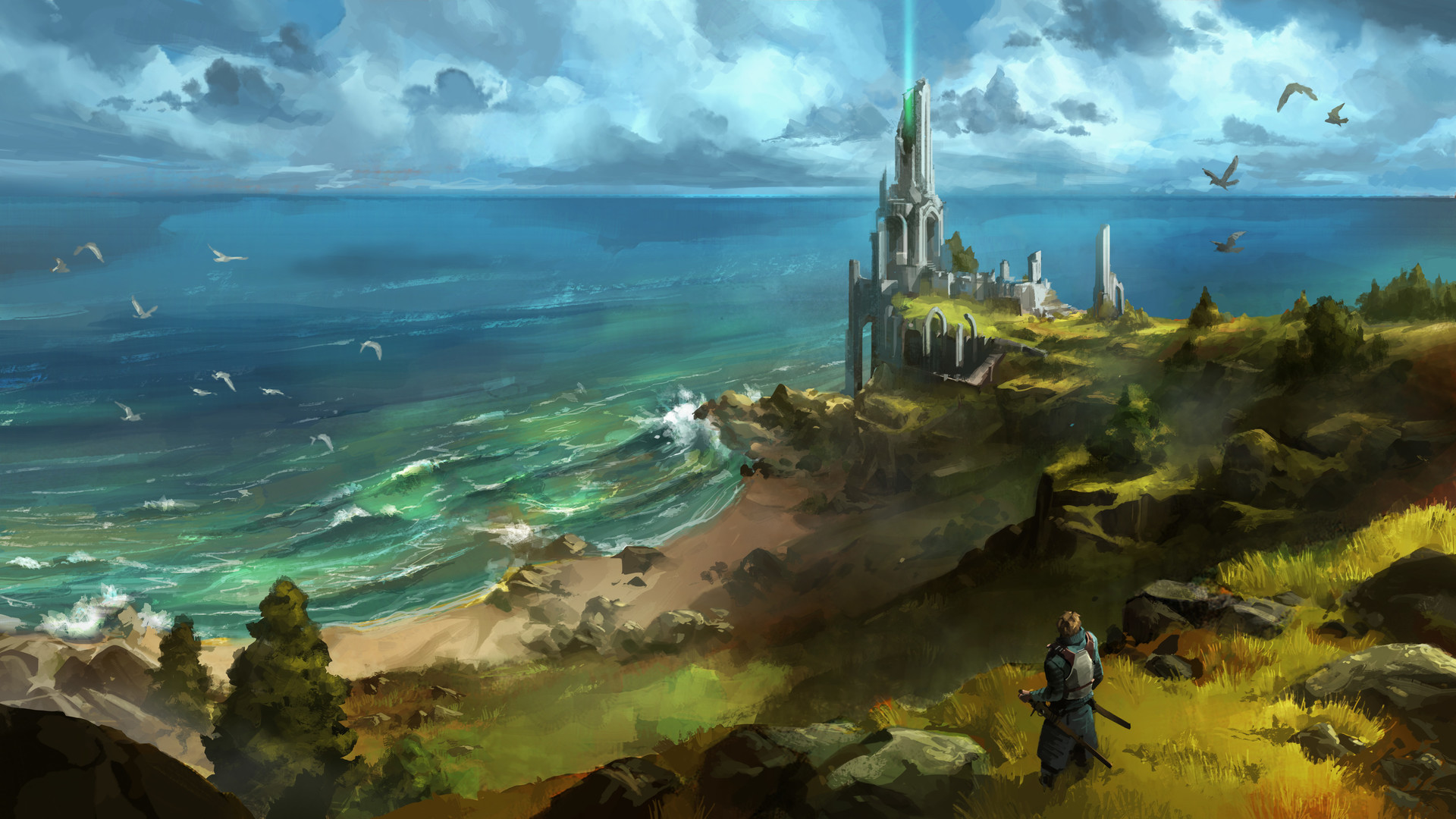
Wakova is the region in eastern Aevira that stretches north from the mineral-rich Gilded Peninsula to the south of the Vesper River. The area holds various terrains and biomes such as golden dry savannas, grasslands, and scattered deserts.
Wakova has a tropical-arid climate, usually with varied heat and humidity. Some microclimates dot the region, with swamps and forests near coastlines that maintain a higher humidity. The climate typically alters between wet and dry seasons.
The northern borders are cool and temperate, with the Cerulian Passage separating Wakova and Mistreach. With dense forests and mountains, the eastern borders hold the mountain range of Aevira's Spine, marking the border with Aevira's Heart. On the humid and politically tense southern border, the Vesper River acts as the barrier between Wakova and Nexentrum. Finally, to the west, the Golden Sea and the vast Marrah's Abyss stretch out over the horizon acting as a catalyst for imports and trade.
Notable Features of the region include the Gilded Peaks, which spread across the Gilded Peninsula, and the Golden Coast, which stretches from the Gilded Peninsula to the Vesper River. These get their names from the unique phenomenon that gives bodies of water, beaches, coastal mountains, and cliffs in the region a golden shimmer. In addition, five large lakes are spread throughout Wakova, allowing for local wildlife and settlements to thrive.
History
Wakova is where the most ancient remnants of civilization lay. Over 10,000 years ago, the elves founded various settlements among the mountains, hills, and savannas of the region. These elves thrived for millennia its harsh climate, outpacing the native orc tribes in numbers and technology.
When the Aetherii Empire was established, the region quickly became known to provide the best soldiers of the empire's army. In addition to this, bordering the eastern seas allowed sailors and trade to prosper. The eastern coast of Wakova became known as the Golden Coast, which found its name from the sheer amount of gold the ports produced from trade, as well as the gilded waters that stretched along the coast.
When humans arrived in Aevira, which was known as Eilsimar by the elves of the time, Wakova was one of the few elven nations that accepted them with open arms. Sovereign of Wakova at the time, Aelithar Lunaris, saw the value humans brought to the lands & his people, granting new knowledge and perspective to the elven perception of time. Other elven nations, however, did not take too kindly to the humans they saw as parasites, and Wakova quickly became a land of battle during the Aetherii Civil War.
Seeking a place to protect his people from war, the pacifistic Aelithar transformed his place of research, the Lunaris Sanctum, into a fortress. He would lead his people to the fortress in droves, protecting many from death. However, his heroism would soon turn into failure after the Sanctum fell to loyalist forces of the Aetherii Empire, slaughtering many of his people in the process.
After the sanctum became lost to history, the Desolate Cascade made sure to put the final nail in the coffin for the once benevolent fortress. During the Cascade, many elves and dragonborn of Wakova would lead humans to safety, which would would take their lives. The humans who were saved were grateful for those who allowed them to prosper, and the first human settlements would be built upon the benevolence of those who came before.
These scattered survivors would respond to the destruction of their new home, loss of food sources, and dangerous predators, by setting out to explore Wakova and its surrounding regions in search of a more sustainable environment. Some of these survivors would come to find the city of Aegis, a massive city surrounded by walls and natural protective mountains to its back. Aegis would become a bastion of human civilization, facilitating the spread of humankind throughout Wakova. Eventually many humans would coin the term: Sine Aegis non est Wakova; "Without Aegis, there is no Wakova", empathizing the significance of city in the region.
With the rise of the Aegis Ascendancy, Wakova has become very different than it once was. Instead of promoting freedom and autonomy as it once did, Wakova is now a place of religious structure and martial law.
Governance
Wakova holds a tight confederation of city-states, rather than a unified nation. Under the banner of the Aegis Ascendancy, each city-state maintains their own militia and government, with representatives from Aegis traveling to each city once a year to discuss issues related to trade, relations with other cities, and inter-border disputes. Each city is carefully overseen by a member of the Quaronar Council.
The Aegis Ascendancy is ruled by Sovereign Ardeiria Valiron, who resides within the capital city of Aegis. With the assistance of the Quaronar Council and faith of the Order of Teno, the young theocratic confederacy rules with a respected iron fist throughout the region.
Society
Wakova once thrived on open trade and cultural freedom, but with the rise of the Aegis Ascendancy this has become far from the truth. After the Nexari Purge, many hoped that they would be able to return to the lives they before the conquering
of their homeland. However, it became clear that the Aegis Ascendency
and the Order of Teno were both intent on exerting control over all of
Wakova. Despite initial push back, both have become seen among the majority of citizens as a force
of common good.
A member of Wakovan society in present day is reserved, devout in their distrust of outsiders, and their unwavering loyalty to Arderia Valiron's Aegis Ascendancy and Order of Teno.
Culture
The unique and diverse cultures Wakova once lauded itself to have dwindled. The elven expression, "N'Rathla' Sha", directly translates to "not blood-bound friend". Once a general expression of friendship and acceptance, it is now viewed as an expression of fear and prejudice. The many citizens of the region hold a variety of beliefs and opinions, but for millennia one stood: Wakova belonged to those who built it, regardless who laid their hands on it; they became Wakovans the moment they made it a better place with hard work and dedication.
This belief became less common after the invasion of the Nexentrum Empire. Before the Aegis Ascendancy, citizens were usually viewed to be pacifists, only using force when provoked. The Promised War sparked the creation of a plethora of anti-war propaganda against the Empire during it's invasion, along with the once popular song: Let the Sword Grow Rust. After the establishment of political settlements like Seraph's Dawn, many felt that the unique practices and identities they built for themselves were being eroded by the Empire appointed nobility and merchant classes instructed to oversee the cities in the region.
Religion
Wakova was once known for its religious freedom, standing in stark contrast to the Nexetrum Empire. While the region remains diverse in many ways, the religious climate has dramatically shifted in recent years with the rise of the Order of Teno. Under the Codes of Aegis, the Order has been established as the only true faith of Wakova. Worship of non-state-sanctioned faiths is illegal and the majority of citizens no longer welcome them, making it difficult to pray to any other gods when not behind closed doors.
Worship of the Morngaulir is allowed under the Codes of Aegis if paired with the tenets of Teno, however it is frowned upon if anyone other than a dragonborn is worshiping the faith.
Trade (WIP)
- Past Relations: Nexentrum Empire and Wakova once shared friendly diplomatic and economic ties.
- Trade Route: The Golden Road, connecting Nexentrum and Mistreach, was a busy trade route used regularly by merchants
- Beyond military alliances and national pacts, the cities of Wakova were united by a mutual interest in thriving trade.
- Commerce played a central role in their cooperation, more so than politics or borders.
- Wealthy trade guilds and financial organizations operated across the Golden Coast, influencing local economies and took advantage of citizens.
- The Aegis Ascendancy identified and took control of these groups, restructuring trade under a tithe-based port system.
- This system required merchants to pay a fixed portion of profits or goods at each port under Ascendancy control.
- Wakovan territories are highly profitable for traders due to secure routes and open markets.
- Most merchants travel without guards—bandits have been either wiped out or driven away.
- Any attack on Wakovan land or people is met with swift, brutal retaliation.
- Even the savage Marauders are wary of provoking Wakovan forces, especially near caravans.
- The absence of heavy Nexentrum taxes in Wakovan frontier regions makes trade even more attractive.
- Many traders operate primarily within Wakovan lands, though some do cross into Nexentrum for additional opportunities.
- The Wakovan authorities do not interfere with cross-border trade, allowing merchants some freedom.
- The Aegis Ascendancy enforces strict bans on drugs and alcohol—possession or smuggling is met with severe punishment.
- Wakova's Trade Role: Wakova dominated long-distance trade, especially maritime commerce.
- Port Towns: Most goods passed through Wakova’s coastal ports, giving them significant control over imports and exports.
- Fish, mercenaries, merchants, pirates, ships, livestock, Divine magic, fine crafts, fruit, textiles, wool, gold
- Relies on Mistreach for: Weapons, Armor, Tools, Adamantine, Gold, Valuable Resources
Military
Before the rise of the Aegis Ascendancy, Wakova did not have a formal military. In times of war, militias were created when needed. However, with the Ascendancy came the formation of a true military structure. In present day, the Army of the Silvershield is divided into three distinct groups: Shield-bearers, Shields-at-arms, and Levies.
First are the Shield-bearers, a knightly caste that typically serve as the face of the military, representing martial and religious authority among political and civilian interactions. In times of war, they act as overseers rather than commanders, able to issue orders to shields-at-arms and levies without holding official rank.
Second are the Shields-at-arms, the core force of the military that is well-trained, well-equipped, and well-disciplined. They are the backbone in times of war; seen as the standard troops you would most commonly see on the battlefield. Outside of war, shields-at-arms are seen patrolling, maintaining order, and assisting Shield-bearers who are upholding the law.
Third are the Levies, conscripted or tributary soldiers that hail from the cities under the Ascendancy's rule. The quality of these soldiers varies from region to region, with most cities sending inexperienced youth to fulfill quotas. Cities where the Ascendancy holds more power and influence may send better troops, even at the expense of a city's own defensive capabilities. Rarely, however, are levies seen outside of war times, being deployed almost exclusively during large-scale warfare. When levies begin to mobilize, it is a sign that war is just over the horizon.
In addition to the formal military of Wakova, there are the informal units of the loyal dragonborn. Specialists, commanders, & elites, these forces help train recruits alongside Shield-bearers. While not a formal branch of the military, the dragonborn have a strong presence among it. They are culturally separated from the standard citizens of Wakova, making them both feared and respected. During times of war, they operate independently as commanders and advisors within the ranks of the military. These Dragonborn bring unique tactics, traditions, and weapons to an often-close-minded military. Some cities even host dragonborn to train troops within their walls.
Within the Shields-at-arms, dragonborn are scattered throughout the ranks as squad leaders, drillmasters, and field commanders. While this is rare, it is common enough to be noticed, while not being seen as standard practice. Their presence often increases discipline and lethality among the units they attach themselves to too.
Within the Shield-bearers, dragonborn are even more rare due to the religious and cultural differences they bring. A few have adopted the Order of Teno as their faith, rising through the ranks as any other citizen would, however, these cases are exceptional, seen as living symbols or divine champions of the Precursor Dragons by some, or heretics by others. These units often serve in specialized roles such as elite enforcers, inquisitors, or ceremonial guardians.
The influence of dragonborn in Wakova is rarely seen, but often felt. It is not common for large units of dragonborn to form within the military, but they leave their mark by providing training, tactics, and victories to the Ascendancy. Respected by many, but not fully trusted, they are admired for their skill, but closely watched with suspicion, even by the those who fight and serve under them.
Dragonborn tend to operate under agreements, honor-bound services, or personal oaths rather than strict chains of command. It is a widely held belief that the existence of these dragonborn within the ranks of the Aegis Ascendancy have contributed massively to the victories of the young theocracy.