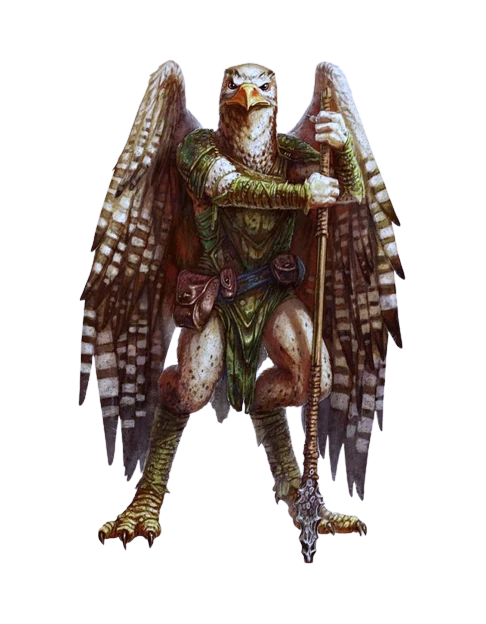
Birdfolk, sometimes called aarakocra, were a rare lineage of avian Mortalborn in Somnum. They averaged about five feet tall, with light, hollow bones that kept them weighing between eighty and one hundred pounds. They reached adulthood by age three and lived short lives compared to other smallfolk, rarely surviving more than thirty years. Their feathers ranged widely in coloration, from typical whites, browns and grays to brilliant reds and yellows, and they possessed similarly bird-like, round eyes of various colours. Their bodies had typical humanoid features, with narrow heads and long arms that ended in three fingers and an opposable thumb. Their feet had four talons, and they possessed wings on their back that averaged twenty feet in wingspan.
Birdfolk were born from incubated eggs in high mountain nests, where their parents raised them communally alongside other families of their "flock". They would take two to three months to hatch from their egg. Their communities were most often found in remote mountains and high plateaus, places close to the open skies that defined their lives. Much like the birds they resembled, male birdfolk had commune-specific mating rituals they would use to attract females. In most communities, females were thought to be more emotionally controlled and typically elected to political or religious office. Though males were not forbidden from taking major roles, it was culturally understood that women were chosen for leadership.
Believing themselves to be natives of the Realm of Air, birdfolk societies valued freedom above all things. Open sky was sacred, and anything that bound them to the ground for too long was seen as stifling; this concept of freedom was integral to their lives, and many were baffled by the idea of ownership. They avoided enclosed places, rarely digging deep into earth or stone, and preferred temporary or lightly built dwellings that did not impede their movement into the air. Many of their cultural quirks reflected this devotion to air and freedom. They treated confinement or imprisonment as one of the greatest possible offenses, and often refused to stay long within the walls of towns and cities of other smallfolk.
From below, they looked much like large birds, and only when they descended to roost or walk could another smallfolk even tell that a birdfolk was humanoid. Most birdfolk enjoyed solitude and had little interest in the affairs of grounded folk. As such, those who left their communities often did so following a greater purpose, which further isolated them from the customs of other smallfolk. In the broader societies of Somnum, when not outright gawked at, they were often seen as aloof, or downright criminal due to their disregard for the concept of ownership, and many smallfolk struggled to read the expressions from their beaks and round eyes. In particular, the relationship between birdfolk and Crowfolk was a fraught one; birdfolk considered them inferior and to be paying for crimes against their kind, and crowfolk hated them for it.
Birdfolk possessed keen eyesight that allowed them to spot details at great distance, but what really set them apart fom other smallfolk was their talons and their power of flight. Sufficiently strong or magical birdfolk could flap their wings powerfully enough to create great gusts of wind, though to call such magic often required connection to the Plane of Air. Their light frames and wings defined their every advantage, though they relied heavily on open skies to make full use of them. On the ground, however, they moved slightly awkwardly compared to most creatures of similar size.
They spoke the local tongues of the regions where their flocks settled, often punctuating their speech with chirps for cadence as they lacked the facial muscles of other smallfolk. They also spoke Aarakocra, a language composed of bird-like sounds that was derived from the Auran Primordial dialect. Some also spoke auran themselves, the tongue of the elemental air. Their voices carried a lilting, whistling cadence, sometimes slipping into trills and clicks that echoed the sounds of the wind.
Similarly, birdfolk names reflected the cries and whistles of birds, often sounding sharp, short, and airy to other smallfolk. Their naming conventions varied by flock, but many names carried quick, clipped syllables or rolling sounds such as Oorr, Quaf, or Deekek.
Adventurers among the birdfolk were rare, as they enjoyed peace and solitude and had little interest in dealing with other peoples or spending time on the ground. It took an exceptional circumstance for one to leave the tribe, and in such cases they often gravitated toward Adventuring Classes that matched their flight and keen sight. Neither treasure nor glory sufficed; a dire threat to their people, a mission of vengeance, a catastrophe, or a Great Purpose set by their elders typically lay at the heart of a birdfolk adventurer’s path. When such calls arose, they tended to favor roles such as Martial Artists or Rangers, though Clerics tied to the open sky appeared from time to time. Those who chose other classes were uncommon and usually driven by a singular temperament, obligation, or divine contact strong enough to pull them from the high peaks and back into the wider world.