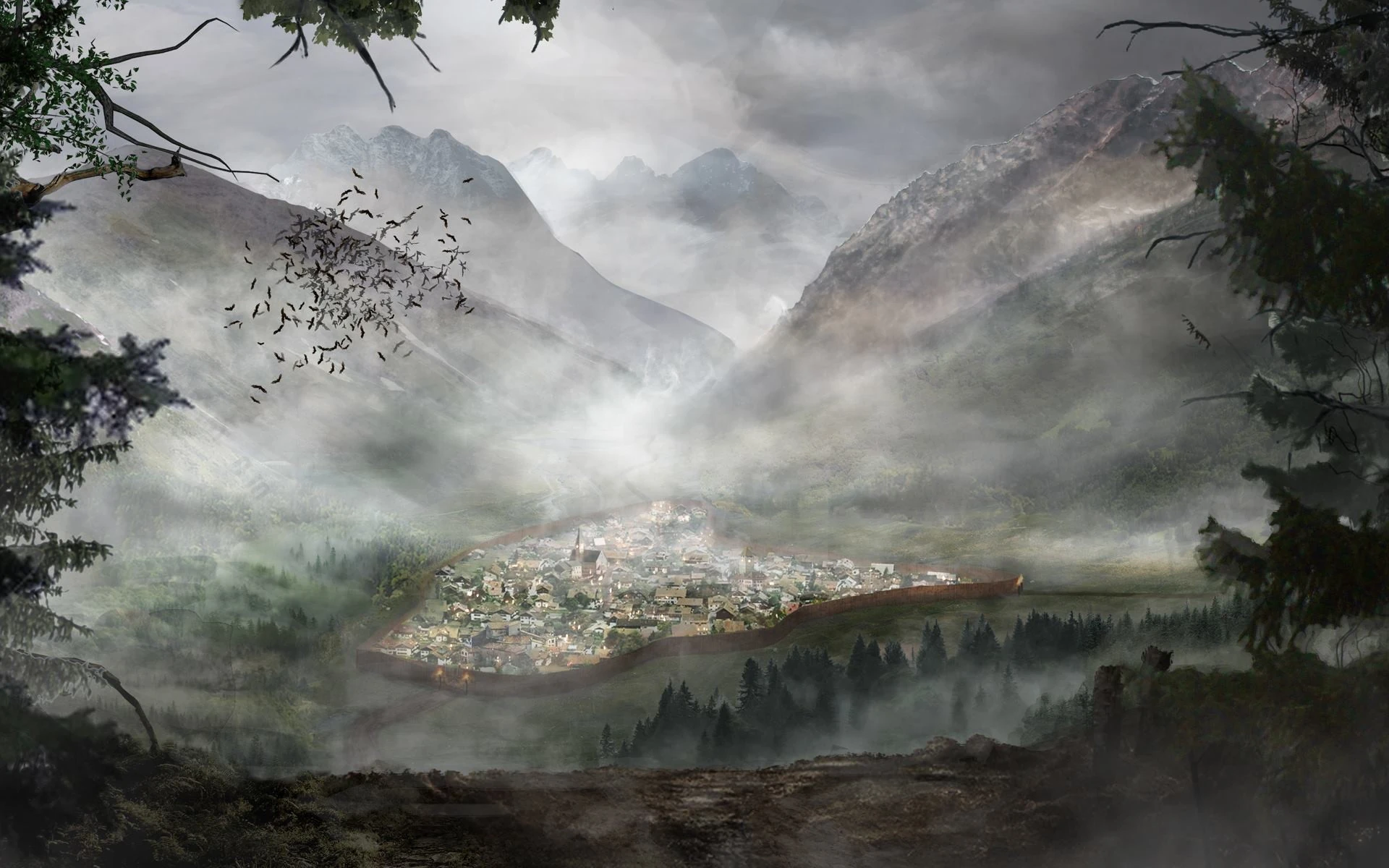
Nestled in the warmest part of the Zarovich Valley, the fortified walls of Vallaki contained a large populace. Originally established as a trading hub, it was thought to be named after its primary noble house, the Vallakovich, but had no true singular governance. However, when Strahd von Zarovich came to control the valley after the Wedding That Never Was, the town's numbers dwindled, as did the morale of its residents.
Vyacheslav Vallakovich used the depressed state of the town to assume power as its sole Baron, building large fortifying walls modified after Krezk, constructing the Vallaki Burgomaster's Mansion, and erecting a statue of himself in the Vallaki Town Square. A truth, not known to the townsfolk, was that their Burgomaster had made a deal with the Vampire lord; Strahd would not overly meddle in Vallakian affairs, at the cost of an increasing madness in the Vallakovich family.
Years after this deal, the town became known as a refuge from Strahd as his visits to terrorize the populace became increasingly rare. The Vallakovich family used this as a sign of their divine right to rule, but while Vallaki was not as oppressed by the vampire lord as the Village of Barovia, it maintained its own form of subjugation through its political structure. Functioning as a near-police state for hundreds of years, Vallakians were as hopeless as other Barovians. Education was not provided to those not of noble houses; the lower classes were only taught to fear their neighbours and venerate their ruling houses. The average Vallakian did not know the history of even their own town, much less of the wider valley of Barovia.
The town's insularity and lack of education was especially true under the rule of Burgomaster Vargas Vallakovich, who himself did not know his family's history. Vistani, thought to be servants of Strahd, were banned from the town's border, and anyone entering or exiting the city was subject to a full search, with a record of their personal items. Vargas forbid the town mention Strahd's name, and forced the residents to attend near-weekly "celebrations" to improve morale.
Due to the physical restrictions in place as well as Vyacheslav's deal with Strahd, it generally hovered at a stable population of 1500 people, though poverty and misery abounded.
Word count: 364