1. Locations

Waterdeep, the City of Splendors

Also called: The Crown of the North, Jewel of the Sword Coast, the Deep
Author: The Librarian, Eternal Witness of Velkarn

“To understand Waterdeep is to understand Velkarn's beating heart—sometimes noble, sometimes corrupt, but always alive. A city with so many masks, even the gods are unsure which one it truly wears.”
—The Librarian

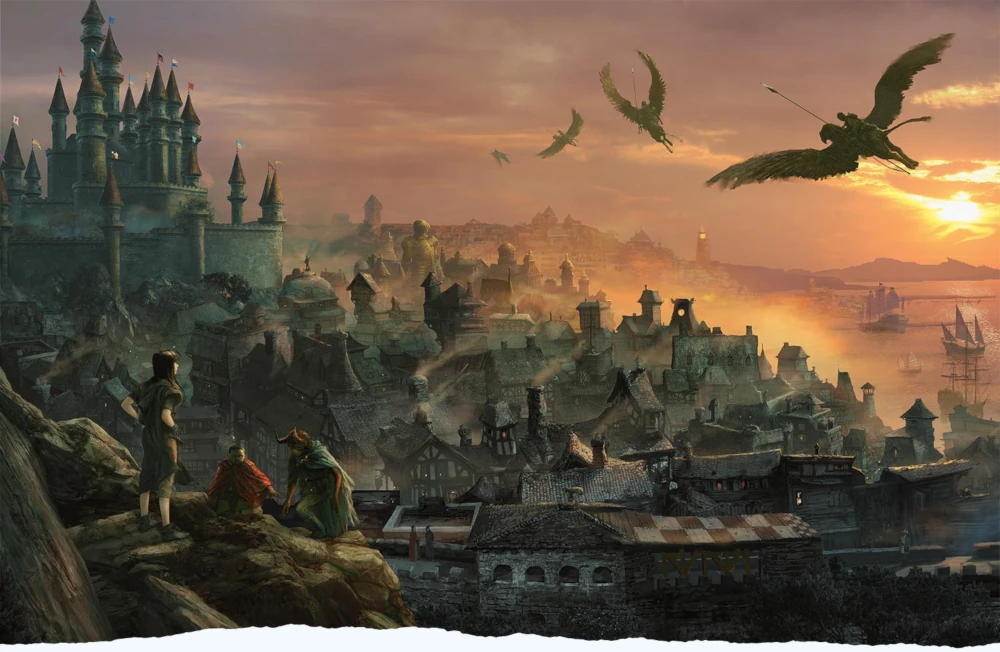
Perched upon the western coast of Faerûn, where cliffs tumble into the Sea of Swords and fog drapes the morning like a noble’s cloak, Waterdeep—the City of Splendors—stands as a marvel unmatched. Neither the largest nor the oldest city in Velkarn, Waterdeep remains its most influential, a confluence of power, commerce, magic, and intrigue. If the planes have crossroads, then this city is surely one of them.

Waterdeep has endured countless transformations: from ancient elven port, to the nascent trade post of Aelinthaldaar, to the sprawling capital of modern Velkarn politics. In the Contemporary Era, following the Tyranny of Dragons and the Divine Contention, Waterdeep is perhaps more complex and more precarious than ever.

Kanka is built by just the two of us. Support our quest and enjoy an ad-free experience for less than the cost of a fancy coffee. Become a member.

Historical Significance

Waterdeep’s history stretches across epochs. First founded by the Melairkyn dwarves and the elves of Illefarn, it became a surface settlement only in the centuries after the fall of Netheril. By the time of the Age of Humanity, it had become a flourishing trade hub. Its rise accelerated during the Age of Unrest and the establishment of the Lords of Waterdeep, whose masked rule stabilized the city during periods of war and wizardry.

In the late 1400s DR, Waterdeep played a pivotal role during the Tyranny of Dragons, serving as the stage for the Council of Waterdeep, the only successful unification of Faerûn’s major factions against a common threat. During the Battle of Waterdeep, the city suffered heavy magical and draconic bombardment at the hands of the Cult of the Dragon. The wards were shattered, the skyline scorched, but the soul of Waterdeep endured.

In the aftermath, Waterdeep reemerged as a city not just of splendor, but of survivors. Its leaders now walk the line between power and ruin, peace and deception. 

In the Contemporary Era, Waterdeep served as the enigmatic chessboard of The Grand Game, with 500,000 gold pieces hid beneath its streets. During the chaos, a member of the Hype Squad set off a fireball in a crowded alleyway launching the city into martial law under the Cassalanters' control.

Legacy of the War of Dragons

“The city survived a god. It did not escape unchanged. The stones remember the weight of dragonfire, and the dreams of children still echo with wings.”
The Librarian

The War of Dragons—known formally as the Tyranny of Dragons, and colloquially as the Year of Fire and Fang—left permanent marks on Waterdeep. While the Well of Dragons bore the brunt of Tiamat’s wrath, the Battle of Waterdeep was a flashpoint that nearly ended the city.

Physical Scars:

  • Sections of the Dock Ward and Castle Ward remain rebuilt but unrestored—new stone laid over broken history.

  • The crater outside the South Gate, where Fenrir’s gold mask ignited mid-battle, has become an unofficial memorial.

  • Ward-wide magical protections, formerly held by the Blackstaff and city mages, are now fractured. Some fear they can no longer repel extraplanar threats.

Cultural and Political Shifts:

  • A new civic holiday, Remembrance Day, honors the Five Guys and the fallen soldiers of the Council Alliance.

  • The Council of Waterdeep, once only a wartime coalition, is now a permanent advisory body to the Lords and Open Lord. Each of the Five Factions of Velkarn have embassies throughout the city for their agents.

  • Dragon cult iconography is banned in the city. Possession is punishable by exile or death.

Factional Aftershocks:

  • The rise of Leosin Erlanthar, Enna Baenre, and Onthar Frume as symbolic heads of the Harpers, Zhentarim, and Order of the Gauntlet has created a new balance of power—and new tensions.

  • The public memory of the war has split among generational lines. Older nobles resent the adventurer influence; younger Waterdhavians view the Five Guys as near-mythic.

  • Prophets now claim the final verse of the original Cult prophecy remains unfulfilled. The Watch quietly investigates these rumors.

Government

Waterdeep is nominally ruled by the Lords of Waterdeep, a council of masked figures whose identities are protected by law and magic alike. They are overseen by the Open Lord, the only public member, who traditionally maintains the city’s external diplomacy and policy. Since the events of The War of Dragons, the Lord’s authority has been quietly curtailed by factional influence.

In truth, Waterdeep is now governed as much by its powerful factions as its Lords. With Laeral Silverhand's power waning, the Masked Lords find their power draining from the city day by day. In the wake of the Battle of Waterdeep, three figures stand prominent:

These three, through a mixture of personal rapport, mutual respect, and political compromise, have woven an uneasy peace—one often threatened, yet never wholly broken.

The Masked Lords

“A king rules from a throne. A god from the heavens. But Waterdeep? Waterdeep is ruled from behind a mask—and beneath it, often, is someone far more dangerous than either.”
The Librarian

The Masked Lords of Waterdeep form the ruling council of the City of Splendors, a collective of appointed individuals who govern with equal vote and influence, save for the Open Lord, who serves as their chair and sole public representative. The identities of the Masked Lords are protected by powerful magics, ancient laws, and cultural reverence—even speaking one’s own identity while wearing the mask is considered treason.

This system, born in ages past to prevent corruption by outside forces and powerful guilds, is paradoxically both Waterdeep’s greatest safeguard and its deepest vulnerability.

The council typically includes twelve to twenty Lords, drawn from nobility, trade guilds, arcane societies, and occasionally adventuring backgrounds. Lords are selected by the Open Lord, vetted through magical oaths, and bound magically to silence regarding their service.

The Masked Lords:

  • Meet in secret beneath Castle Waterdeep, in the Hall of the Lords

  • Wear enchanted black robes and identical mirrored masks, obscuring all features, voices, and magical auras

  • Can only be unmasked through vote, betrayal, or death

Even divination spells are blocked or distorted by the enchantments of the Lords’ Hall, maintained by the current Blackstaff or designated Archmage of the city.

Masked Lords in the Contemporary Era

Following The War of Dragons, the Council saw unprecedented tension and outside pressure. While the Lords technically held authority, true power fluctuated between the Open Lord, the factions of Velkarn, and individuals like Leosin Erlanthar, Enna Baenre, and Onthar Frume.

At present:

  • The Open Lord, currently Laeral Silverhand, balances tenuously between tradition and political survival.

  • Several Masked Lords are suspected of being aligned with or directly influenced by:

    • The Lords' Alliance, as Waterdeep is the leading city amongst the allied members

    • The Zhentarim

    • The Harpers, albeit subtly

    • Waterdhavian noble houses and trade guilds with unclear loyalties

It is widely believed—though never proven—that at least one current Masked Lord is a changeling or doppleganger, planted during the height of the Unseen’s activity during the Grand Game.

The Masked Lords are not corrupt by design—only by context. For what mortal can be given anonymous power and not eventually believe themselves immune to consequence? History teaches that the mask protects Waterdeep. But I ask: from whom?


Culture and Economy

Waterdeep is a city of contradictions, but it is also a city of culture. Art, theater, and music flourish within its walls, with bardic colleges, opera halls, and street performers found in nearly every ward. The city is famed for its tolerance—on the surface—and for the blending of a thousand tongues, dialects, and customs. Within its walls walk humans, elves, dwarves, goliaths, tieflings, aarakocra, and stranger still.

Its economy, driven by trade, innovation, and arcane industry, remains the most formidable along the Sword Coast. The Guilds of Waterdeep regulate every trade from alchemy to carpentry, and though corruption runs deep, so does opportunity. Even the poorest corners of the Dock Ward hold dreams that spill across the seas.

Since the war, a strange mixture of rebuilding and profiteering has gripped the city. Adventuring companies, mercantile barons, and planar entrepreneurs vie for space and power. Rumors swirl of subterranean mines rich with spellgems, and new trade routes opened to planar ports.

Districts

Each district of Waterdeep bears a distinct soul, from the gleaming towers of the Castle Ward to the shadowy depths of the Dock Ward. The city’s wards include:

  • Castle Ward: Administrative and civic heart, home to Castle Waterdeep and Blackstaff Tower.
  • Sea Ward: Wealthy and pious, filled with temples and noble estates.
  • North Ward: Quaint and quiet, often home to retired adventurers.
  • Trades Ward: Bustling and loud, the commercial lifeblood of Waterdeep.
  • Southern Ward: Gateway for travelers and traders; alive with caravans and inns.
  • Dock Ward: Chaotic and rough, ruled by coin, muscle, and whispers.
  • City of the Dead: The vast, walled cemetery—peaceful in daylight, haunted at night.

Landmarks

  • Castle Waterdeep: Seat of the Lords, towering above the western cliffs.
  • Blackstaff Tower: Residence of the archmage of Waterdeep, current occupant unknown since Vajra’s retirement.
  • The Yawning Portal: Legendary inn and entrance to the Undermountain, once run by Durnan, now curated by a rotation of retired adventurers.
  • Mount Waterdeep: A sacred and strategic vantage point; rumored to house ancient planar gates.
  • Field of Triumph: Grand coliseum of games, duels, and public events.
  • The Market: One of the largest open-air marketplaces in Faerûn, filled with strange wares and stranger merchants.
  • House of Heroes: A temple to Tempus that also acts as a monument to the fallen from the Battle of Waterdeep.
  • Trollskull Manor: A bar run by the notorious Hype Squad

Taverns and Establishments

“In Waterdeep, power is not just forged in halls of stone—it’s spilled over tables of ale and whispered between songs. A tavern can be a throne or a grave. Often both.”
The Librarian

Taverns are more than drinking halls in Waterdeep—they are nexuses of intrigue, alliance, and memory. After The Grand Game, many establishments have taken on symbolic status, either as factional strongholds or neutral territory.

Notable Taverns and Inns:

  • The Yawning Portal – The city’s most iconic inn and the surface entrance to Undermountain. Durnan, its proprietor, remains a fixture of adventurer lore.

  • Trollskull Tavern – Once crumbling, now reborn under the Hype Squad. A symbol of resilience, known to be Zhentarim-affiliated in name, but fiercely independent in action.

  • The Smiling Mask – A neutral drinking house where Harpers, Zhents, and Bregan D'aerthe agents have held tense negotiations. All violence is suppressed by a permanent glyph—rumored to be the work of Jarlaxle himself.

  • The Gilded Eye – Operated by the Order of the Gauntlet as both public hall and recruitment center. Patrons are vetted; the drinks are terrible.

  • The Fishhook – A dockside gambling den once run by Xanatharagents, now owned (quietly) by the Gralhund survivors. Known for low ceilings, high stakes, and triple-thick walls.

Other common spots include Volo's failed restaurant ventures, a rotating series of inns that burn down under mysterious circumstances, and the countless corner-pubs claimed as safehouses by adventurers during the war.

Factions

Waterdeep plays host to the great players of the Sword Coast’s fate:

  • The Harpers: Led by Leosin Erlanthar; vigilant protectors of balance, lore, and liberty.
  • The Zhentarim: Ruthless but disciplined; under Dread Lord Enna, they blend old mercenary grit with political shrewdness.
  • The Order of the Gauntlet: Zealous and righteous, tempered by the restraint of Ontharr Frume.
  • The Lords' Alliance: Still influential, but weakened by infighting and external dependency.
  • The Grey Hands: Once an elite magical peacekeeping force, now decentralized and often co-opted by private interests.
  • The Guilds: Economic might incarnate; officially apolitical, in practice, anything but.

Religion and Temples

“Waterdeep worships with open hands and shadowed eyes. Here, gods walk beside mortals—some openly, some in whispers. Faith is not simply belief, but leverage.”
The Librarian

Waterdeep is one of the most religiously diverse cities in all of Velkarn. Temples and shrines are woven into the fabric of daily life, from grand cathedrals to quiet corner altars. In the aftermath of The War of Dragons, the divine presence has only deepened—Bahamut and Tiamat’s avatars walked the realms, after all, and the city has not forgotten.

Major Temples:

  • The Spires of the Morning – Temple to Lathander, the Morninglord. A center of healing, art, and civic hope.

  • House of Heroes – Dedicated to Tempus, god of battle. Maintains the Field of Triumph and trains warriors for just causes.

  • The Font of Knowledge – Temple to Oghma, a massive library-temple on the edge of the Castle Ward.

  • Shrine of Bahamut Ascendant – Built after the Battle of Waterdeep, funded by the Harpers and Order of the Gauntlet. Site of public mourning, quiet reverence, and now political debate.

  • The Hidden Shrine of Asmodeus – Still outlawed, but rumored to lie somewhere beneath the Sea Ward. Watched closely by the Blackstaff’s agents.

  • The House of Inspired Hands – Dedicated to Gond, god of invention. Site of theological conflict over the suppression of firearm and printing technologies.

Many of Waterdeep’s newer shrines have appeared in Trollskull Alley and the Dock Ward, installed by refugees, cult remnants, and fringe believers. Mystra, Ilmater, Selûne, and Tymora enjoy widespread minor worship.

Closing Remarks

Waterdeep is a city of contradictions—lawful yet corrupt, beautiful yet dangerous, ancient yet constantly reborn. It is a place where heroes become lords, villains wear smiles, and the past never quite dies. For every secret uncovered, a dozen more sink beneath the waves.
For the scholar, the spy, the swordsman, or the sorcerer—Waterdeep awaits.