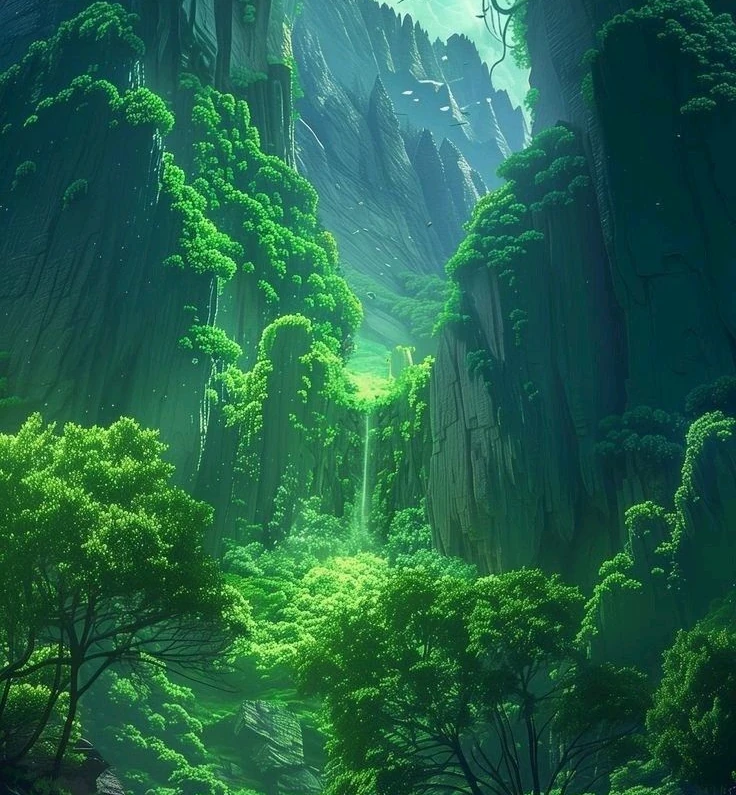
The Reaching Grove was a preternaturally green forest of uncertain origin and steady, inexplicable growth. It lay in the northern reaches of Commona, climbing up against the southeastern face of the Snoutridge. What had once been documented as a modest grove had, over the course of several centuries, become a vast woodland stretching more than four hundred miles across. Locals reported changes within their lifetimes, such as paths vanishing, clearings swallowed whole, and hills that once overlooked farmland now opening into woods.
To many locals, the "wandering" of the wood was a truly divine act. In villages near the forest, shrines had been raised to Elteos of the Reaching Green, the nature god associated with growth, renewal, and wild savagery. No one had ever mapped the interior fully or returned with a clear account of how the forest worked. Some compared it to the Sea of Trees far to the south, another expansive woodland believed to grow with divine backing, though this Grove was not as directly dangerous.
For the Dwarven occupants of Brazenthrone, the forest’s slow crawl toward the Lake of Brass posed did pose a threat. Treecutters were sent out regularly, not only to harvest wood but to fight back a border that refused to stay still. Despite the dwarven fear, nearby Human villages still used the outer forest, as the edges of the Grove were dense but still considered safe for experienced travelers and hunters. People knew not to go too deep, and most kept to familiar routes, lest they be lost in the shifting woods. Guides and charcoal burners had their own rules and superstitions about what parts of the Grove were safe on which days.
At the forest’s center was a place called the Mycowood, a massive glade known to only a few. It was not a forest in the usual sense, but a fungal expanse, where mushrooms stood in place of trees. These stalks were as wide as towers and shed constant clouds of spores. The Mycowood was home to a number of Myconid, rarely seen beyond its borders. According to some fungusfolk, the forest responded to their presence and spread in ways that aligned with the colony's needs; those their involvement was not consensus even among myconids, it suggested a larger purpose behind the forest’s expansion.