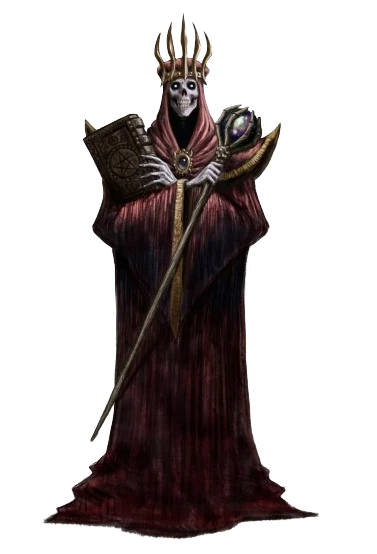
A lich was an almost universally evil form of undead Spellcaster of great power, usually an Archmage, but also possibly a Sorcerer, Warlock, or Cleric. They were feared by mortal beings for their malign magic, their intelligence, and their willingness to embrace undeath for a chance to "live" forever. Lichdom was arguably the most powerful known form of undeath, tethering their soul to the fabric of the Material Realm.
Spellcasters who sought immortality through lichdom tended not to do so for fear of death, but to buy themselves time to further their ambitions; discarding any mortal connections in favor of a solitary existence, they continued to pursue magical power and knowledge. Generally, the countless years of undeath caused their memories to fade and minds to twist, eventually causing the lich to lose any shred of its humanity.
Liches were generally gaunt and skeletal with withered flesh stretched tight across horribly visible bones, but they could vary greatly in appearance depending on their age and level of decay. If their eyes had been destroyed, lost, or rotted away, bright pinpoints of crimson light burned in their empty sockets. They often did not have lips or the necessary organs to produce natural speech, but they had the ability to project speech from their mouths magically, moving the jaw to aid the illusion.
The average lich was a very powerful arcane spellcaster. They could memorize and cast spells as they had in life and required the use of spell components and Spellbook just as a living caster did, though some were able to permanently commit some spells to memory, allowing them to be cast even without material components. Owing to the great depths of time they had to research and practice the Schools of Magic, it was not uncommon for a lich to wield potent unique spells of their own devising.
It was impossible to kill a lich permanently without also destroying its Phylactery, a special item or trinket that contained their life essence. As long as this phylactery was unharmed, the lich was immortal: if slain, its mind and spirit would leave its corpse and flee to the phylactery, and if the lich's old body was destroyed completely, a new body would manifest next to the phylactery within a tenday.
This spiritual form of a lich divorced from a physical body was known as a "lichnee", and it sought to reunite with and possess its body in order to resume its unlife. A lichnee was completely invulnerable and impervious to any attempts to harm it as it fled to its phylactery. It could also temporarily inhabit another corpse, which produced a Wight-like creature that could only cast whatever spells the lich already had memorized. In this form, the lichnee maintained its wits but was limited to the physical capabilities of the corpse, which were quite less than its true form.