What Game am I Playing?
You are playing Dungeons and Dragons, Fifth Edition (D&D5e). This campaign is designed for 4-6 PCs of non-good alignment (the Shadow Agents). This campaign uses the 2014 Legacy D&D5e rules with the following options and constraints:
- Sources: SRD, PHB, DMG, Tasha's Cauldron of Everything, Xanathar's Guide to Everything, The Illrigger (MCDM)
- Races: Human, Sindar (Elf). Khuzdul (Dwarf), Aenarin (Half-Elf), Halfling, Gnome, Drughu (Goliath(, Changeling, Kalashtar
- Classes: Artificer, Barbarian, Bard, Cleric, Druid, Fighter, Monk, Paladin, Ranger, Rogue, Sorcerer, Warlock, Wizard
- Options: All class options, Milestone advancement
Where am I (The Milieu)?
The milieu for this campaign is HârnWorld™, published by Columbia Games. You are on the Isle of Hârn, "The Misty Isle," on the continent of Lythia, on the planet Kethira, the second of five planets orbiting the sun Nolimar, in the Kelestia multiverse.
Kethira
Kethira has one moon, Yael, and three continents:
- Lythia is by far the largest, with more than 75% of it north of the equator.
- Mernat is the second largest, less than one third the size of Lythia, lying southeast of Lythia and almost entirely in the southern hemisphere.
- Kamerand is the smallest, just slightly smaller than Mernat, separated to the west of Lythia by the Haonic Ocean Ocean
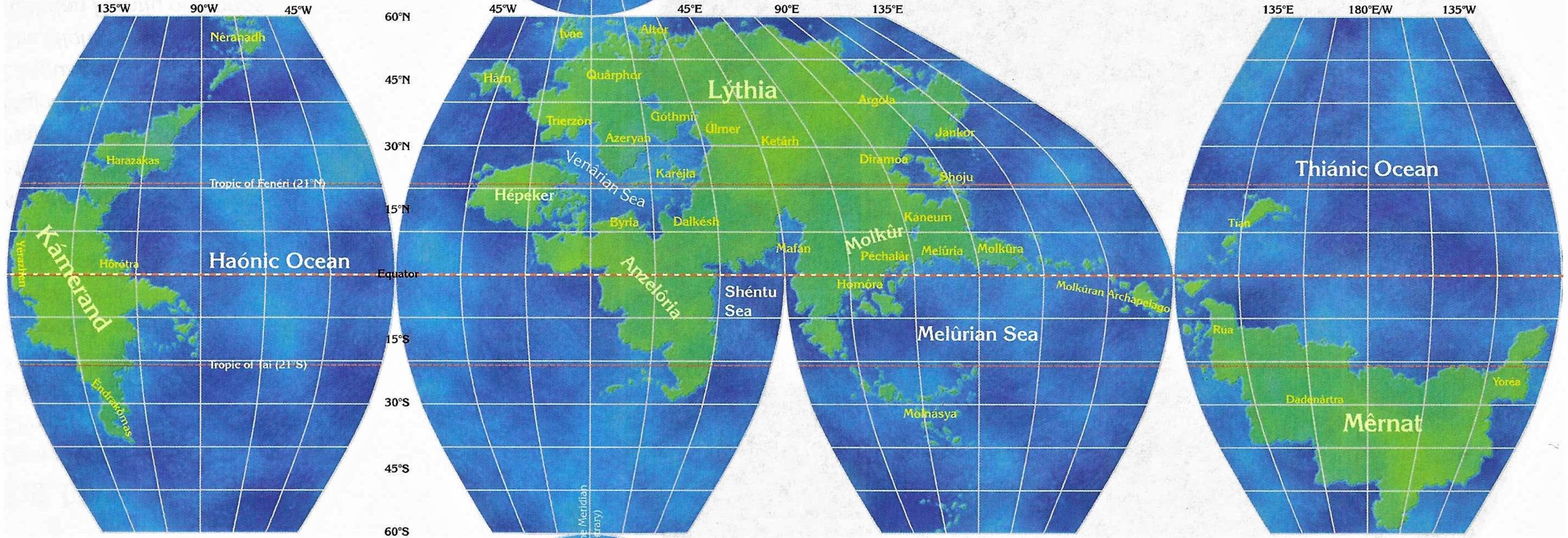
Lythia
Lythia is home to dozens of cultures. The northwest part of Lythia asserts the most cultural influence on Hârn, which is a large island on the western edge of Lythia. Almost all trade in merchandise and culture with Hârn comes from Trierzon (Gaulic/Moorish), Quarphor/Shorkyne (Germanic), Azeryan Empire (Romanesque), and Ivinia (Nordic), with some from the Kerejian League (Hellenic) and Hepekeria (Arabic).
Hârn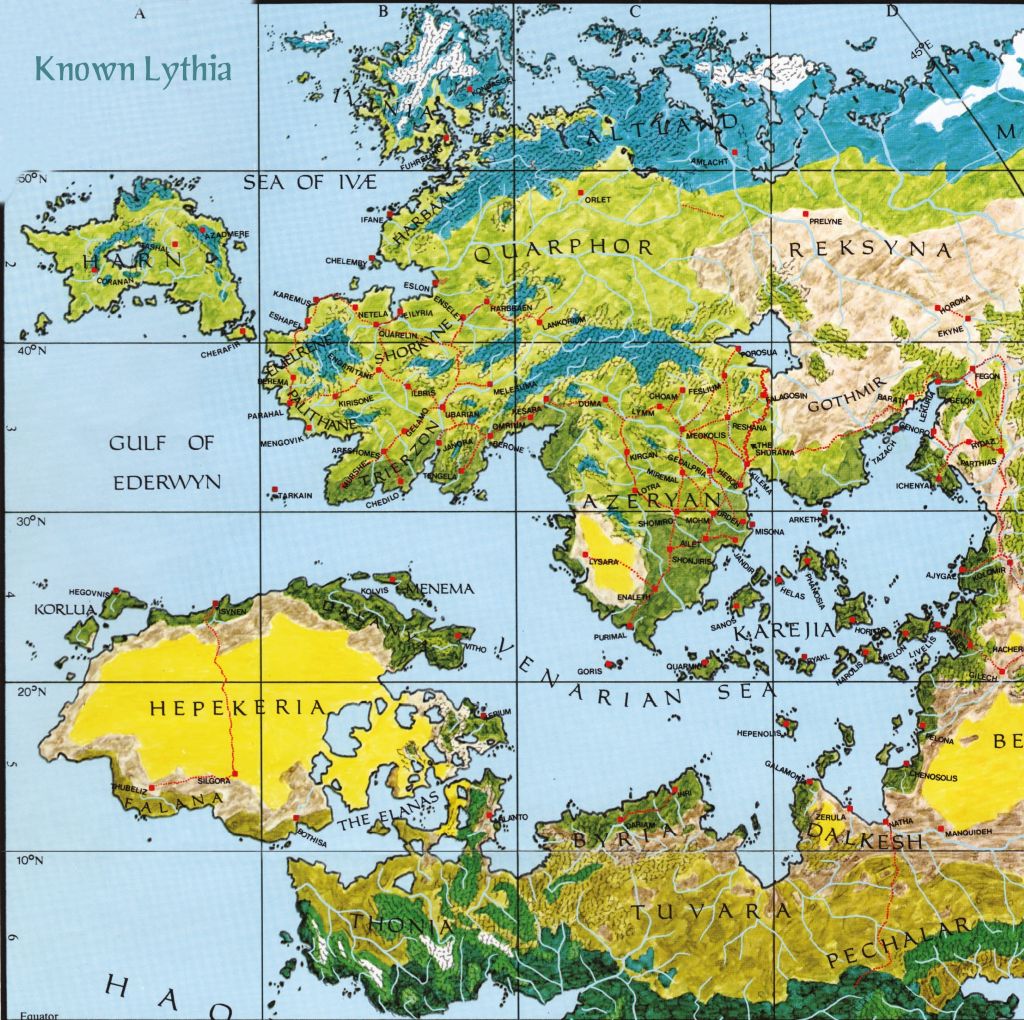
Hârn is a very large island in the northwest part of Lythia, west of the main continent.
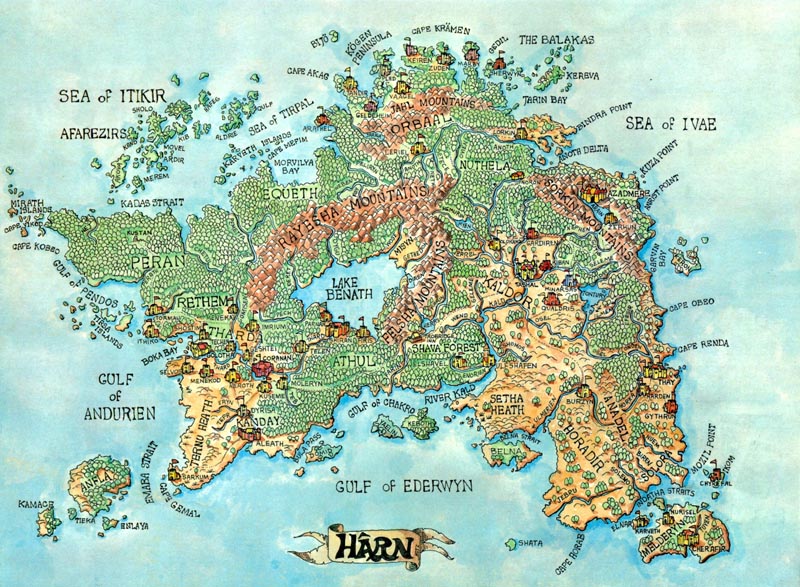
The 40 km wide Melderyni Channel separates the westmost point of the Lythian mainland from the Isle of Melderyn on the southeastern corner of Hârn. The Isle of Melderyn is part of the Hârnic Kingdom of Melderyn. Hârn is considered by Lythians to be a cultural backwater in Lythian affairs. The Misty Isle has a reputation for harboring strange creatures and being the locus for mysterious events. Most Lythians avoid the place.
There are seven human nations and sixteen barbarian tribal nations on the island. Hârn is also home to the Khuzdul (Dwarven) Kingdom of Azadmere, and the Sindarin (Elven) Kingdom of Evael.
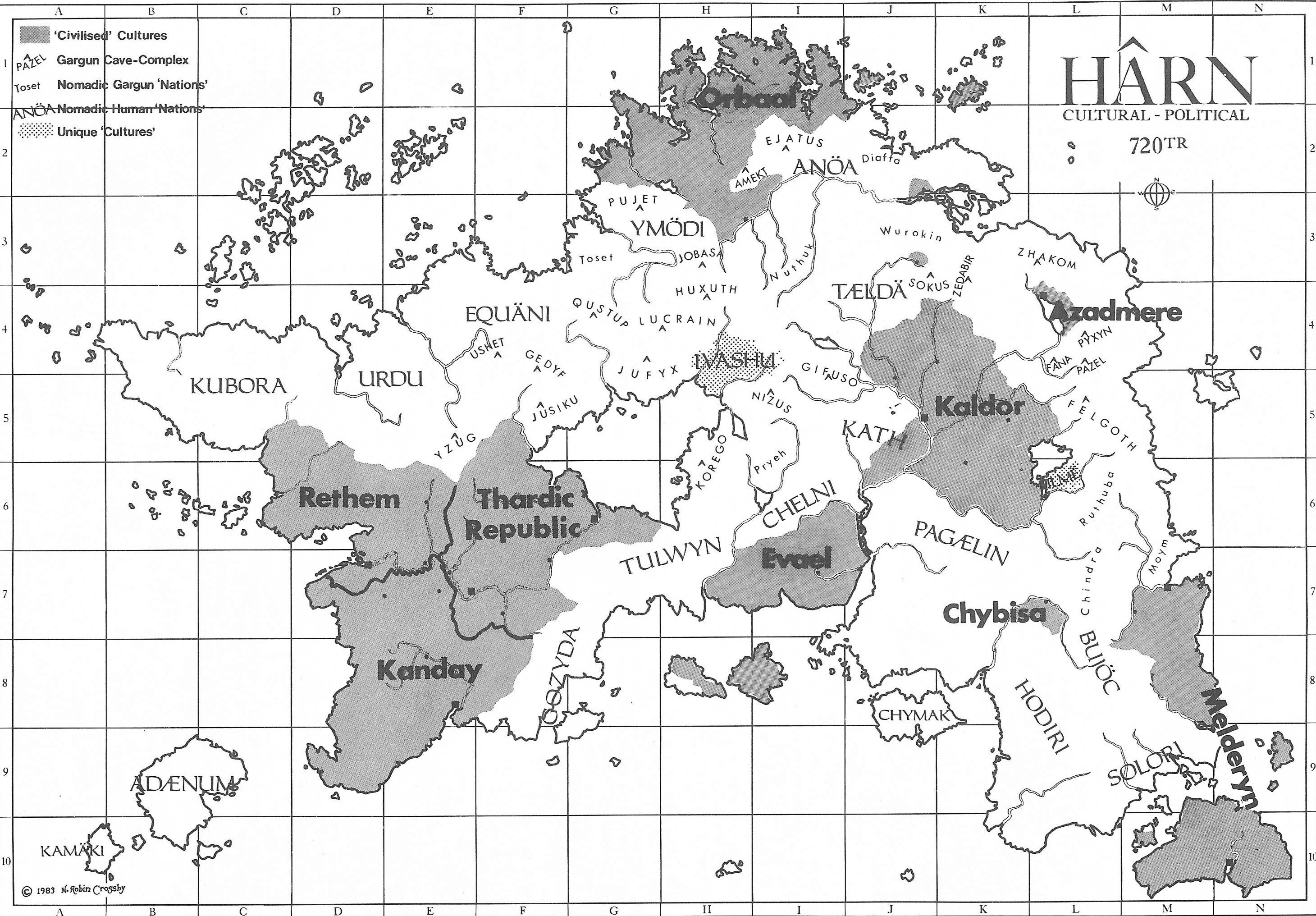
- Kingdom of Azadmere: Khuzdul mountain kingdom, with some human and other non-Khuzan species
- Kingdom of Chybisa: Small Human kingdom between Kaldor and Melderyn
- Kingdom of Evael: Sindarin forest kingdom with very few non-Sindar citizens
- Kingdom of Kaldor: Wealthy Human kingdom on the verge of a succession war
- Kingdom of Kanday: Human kingdom in constant religious conflict with Rethem
- Kingdom of Melderyn (Starting location): Enigmatic Human kingdom, with its capital on the Wizard's Isle
- Kingdom of Orbaal: Norsemen who invaded from Ivinia and suppresses the local Jarins
- Kingdom of Rethem: A tumultuous mostly Human kingdom that arose from a Morgathian theocracy
- Thardic Republic: Mostly Human kingdom that is highly militaristic, hedonistic, and mercantyle
You will begin your journey from one of two locations, depending on your Class (and subclass). Some of the party will depart by boat from Golotha, in the Kingdom of Rethem, on the southwest corner of Hârn. They set sail for Cherafir, a walled city on the Isle of Melderyn, the "Isle of Wizards", in the Kingdom of Melderyn, on the southeast corner of the Isle of Hârn. After a five day trip on a merchant ship they arrive at the port of Cherafir. There they will meet with the rest of the party who hail from the area around Cherafir. Assembled, the party will hear the details of their mission. The campaign starts from Cherafir.
What about Culture, Technology, Magic?
Cultural and technological development on Hârn is roughly equivalent to 14th-15th century CE Europe on Earth, with polytheism (ten gods) and some magic and monsters assumed. Most governments are kingdoms or republics, feudalism is very common, and large areas of Hârn are populated by "barbarian" tribes.
Priests perform miracles. Because of past jihads and populace uprisings where holy miracles were perceived to be overt displays of power, the churches on Hârn manage public displays of divine spellcasting and strive to keep them perceived as miracles or favors from the gods. Almost all use of divine magic is behind closed doors or away from populated areas.
Mages are known but are rare and mostly feared. The arcane guild known as Shek P'Var controls the teaching of non-divine magic and does its best to reign in arcanists of all sorts. This is because of historical events over the last several centuries that resulted in enormous backlash against magic users in general and the Shek P'Var in particular. The Shek P’Var police themselves so that all arcane casters can ply their trade safely.
For some spellcasters, including non-PCs, Necromantic and Radiant spells can operated a little differently. Some PCs and monsters are able to choose how to apply "necrotic" magic as either Bukrai or Death magic. "Necrotic" magic comes in two flavors: Bukrai (undeath) and Death (damage). Bukrai creates and heals undead, both free-willed (Amorvrin) and non-free-willed (Gulmorvrin). Death magic destroys the animus of the target whether living or undead. Clerics of the Death or Grave Domains, Navas Kara, Morgathian Oathbreakers, and Wizards of the School of Necromancy using necromantic magic may choose at will, per spell (not per target) whether the spell they are casting is employing the Bukrai or death effect.
Some PCs and monsters are able to choose how to apply "radiant" magic as either Judgement or Healing magic. "Radiant" magic comes in two flavors: Judgement (damage) and Celestial (healing). Celestial radiant magic heals beings that are not undead. Judgement radiant magic destroys the animus of the target. Clerics of the Life, Pacifist, or Peace Domains and Wizards of the School of Necromancy using radiant magic may choose at will, per spell (not per target) whether the spell they are casting is employing the Judgement or Celestial effect.
Gunpowder and primitive firearms do exist but are extremely rare, owned mostly by Khuzdul, a few Artificers, and some on the nearby continent of Lythia (primarily in Shorkyne, Azadmere, and Trierzon). The Kingdom of Melderyn controls most of the maritime trade, and thus imports, into Hârn, and does its best to limit the import of new and disruptive technologies and magic. Firearms are not illegal, however, and a rare few have been seen around the island of Hârn.
What about Religion?
Ten gods are actively worshipped on Hârn, all with clerical orders, two with fighting orders. Some are proscribed almost everywhere (Agrik, Morgath, and Naveh), and some are worshiped almost everywhere (Peoni, Larani, Save K'Nor). Where and how they are worshipped varies from location to location. Most lay people just offer prayers to different gods as the circumstance calls for (Peoni for healthy crops, Larani for protection) or as deflection (entreating Morgath to hold off death one more day, asking Naveh to give relief from nightmares, soliciting Sarajin to calm the seas).
Three of those gods have only "good" adherents, and are not available for the Shadow Agents story arc. The seven gods available for worship to the PCs are:
Agrik (AG-rik) is the fiery god of War and Battle, Cruelty, Fire, Plague, and Destruction. Agrik is worshipped primarily by warriors and gladiators.
Halea (ha-LEH-uh) is the goddess of Wealth and Pleasure, Commerce, Indulgence, and Hedonism. Halea is worshipped primarily by merchants and courtesans.
Ilvir (il-VEER) is the god of change, mutation, evolution, and extra-planar summoning and travel. Ilvir is worshipped primarily by eccentrics and wanderers.
Morgath (MOR-gath) is the god of Death, Chaos, and Undeath. Morgath is worshipped primarily by Necromancers and free-willed undead. Stress Chaos and Undeath much more than Evil.
Naveh (nah-VAY) is the god of Darkness, Nightmares, and Trickery. Stress LAWFUL much more than evil. Naveh is worshipped primarily by Thieves, Rogues, and Spies.
Sarajin (sa-rah-YEEN) is the god of the Battlelust, Berserkers, and Seas. Sarajin is worshipped primarily by the Northmen and some sailors.
Save K’Nor (SAH-veh kuh-NOR) is the god of Knowledge, Enlightenment, Balance, Music, and Poetry. Save K'Nor is worshipped primarily by sages, arcanists, and bards.
What Race am I?
Nearly all of population on Hârn, outside of the Kingdoms of Evael and Azadmere, are Human. Correspondingly, most PCs are Human. However, adventurers tend to be the most gifted among any population, and many a Sindarin, Aenarin, Khuzdul, Goliath, Gnome, and Halfling have found themselves among others with similar adventurous souls. And, while they are very rare and still shunned by Hârnic "civilization," members of a few exotic races have been seen in the background in the taverns, or in the wilderness, as a part of an adventuring group. Orcs, or Gargun, on Kethira cannot breed with Humans or other humanoids, and are shunned and attacked by civilized society.
- Human and Variant Human: Common.
- Sindarin (Elf): Rare. Distinguished from Humans, with pointed ears and almond shaped eyes.
- Aenarin (Half-Elf): Uncommon. Not easily distinguished from Humans, other than slightly pointed ears and almond shaped eyes.
- Khuzdul (Dwarf): Rare. Can be mistaken for stocky hirsute Humans.
- Halfling: Rare. Can be mistaken for Human children, or abnormally short Humans.
- Gnome: Rare. Can be mistaken for Human children, or abnormally short Humans.
- Changeling: Extremely Rare.
- Kalashtar: Extremely Rare.
- Drughu (Goliath): Extremely Rare. Can be mistaken for an abnormally large Human.
- All Others : Dragonborn, Tiefling, and all creature-types that do not look mostly human are exceedingly rare and will be treated with fear and hostility in all civilized locations
Characters that do not appear Human, Sindarin, Khuzdul, Halfling, Goliath, or Gnome will have serious difficulty navigating locations that are not isolated from populations.
What Class am I?
All standard classes, plus Artificer, are available in the Shadow Agents story arc of this campaign, although there are some restrictions on subclasses for some of the classes. Blood Hunter is not available.
To get the story started, each PC will have a "sponsor" who presents the PC to a group that is selecting adventurers for a special mission. In each of the class sections the sponsor for PCs in that Class, or in some cases Subclass, is identified. PCs sponsored by High Priestess Namani originate from the area around Golotha in Rethem, while all other PCs originate from the area around Cherafir in Melderyn.
Artificer
All Artificer specialties are available: Alchemist, Armorer, Artillerist, and Battle Smith. Note that gunpowder and firearms are not available on Hârn, at least not at the start of your career or in Melderyn. Most Artificers hail from major cities on Hârn or Lythia, where the is access to materials and training. Training for all subclasses is available in Cherafir.
Barbarian
All Barbarian paths are available: Ancestral Guardian, Beast, Berserker, Storm Herald, Totem Warrior, Wild Magic, and Zealot. Barbarians can come from almost anywhere on Kethira, including populated areas and cities. You can also choose to be a tribal barbarian from one of the six barbarian tribes on Hârn. The closest tribes to Golotha are Kubora and Urdu, and those closest to Cherafir are Solori, Hodiri, Chelni, and Bujoc. Some Chelni barbarians have famously made it to Cherafir, as their Shamanic history is quite strong.
| Tribe | Characteristics |
| Peaceful matriarchal isolationists, ignored by the Hodiri and Solori. Any PC barbarian would be an outcast to the tribes. | |
Skilled horsemen, breed warponies with exceptional speed and endurance. | |
| Nomadic horsemen, fierce warriors, especially when mounted. Olive skin, black hair, large nose, stocky. | |
| Fierce warriors, chauvinistic, major facial scarring and tattoos "Arus". Likely hostile to Agrikans. | |
| Fairly primitive, being hunted to extinction by the Spear of Shattered Sorrow (Laranian fighting order). | |
| Mostly peaceful but fierce, facial scarring and tattoos "Arus". Adventurous young Urdu men often end up a Pamesani Gladiator. |
Bard
Available Bardic Colleges: Creation, Eloquence, Lore, Spirits, Swords, and Whispers. Bards fill a variety of niches in Hârnic society, from musical, theatrical, and acrobatic entertainment to sparring with the intellectual or rapier. Most Bards are members of the local College of Harpers.
Cleric
Ten gods are actively worshipped on Hârn, all with clerical orders. Three of those gods (Larani, Peoni, Siem) have only "good" adherents, and are not available for the Shadow Agents story arc. To play a Cleric in this campaign, you must have a secondary statistic of at least 11, as shown in the Cleric table below.
"Core Alignment" indicates the predominant alignment of church adherents and the preferred alignment of church clerics. Priests may be of alignment not more than one step away from the Core Alignment of the church (e.g., an Agrikan Priest can be CE, NE, LE, or N). The exceptions are Morgath (all clerics must be Chaotic) and Naveh (all clerics must be Lawful). "Cleric Alignment" indicates the alignments allowed for Cleric PCs of each god in the Shadow Agents story arc of this campaign.
| God | Core Alignment | Cleric Alignments | Domains | Secondary Stat |
| NE | NE, CE, LE, N | Forge, Tempest, War | STR | |
| CN | CN, CE, N | Arcana, Forge, Knowledge | CHA | |
| CN | CN, CE, N | Grave, Life, Nature | CON | |
| CE | CE, CN | Death, Grave | CON | |
| LE | LE, LN | Death, Order, Trickery | DEX | |
| LN | LN, N, LE | Forge, Tempest, War | CON | |
| N | N, CN, NE, LN | Arcana, Knowledge, Light | INT |
Morgathian clerics have a special place in this campaign.
Druid
Available Druidic Circles: Spores, Stars, the Land, Yael (the Moon), and Wildfire. Druids can hail from almost any area on Hârn or Lythia, or even other continents. They tend to not live in highly civilized areas, although many can be found not too far away from some of the major cities.
Fighter
Available Fighter Archetypes: Arcane Archer, Battle Master, Champion, Echo Knight, Psi Warrior, and Rune Knight. There are as many different reasons for being a Fighter on Hârn as there are fighters. Hârn does have gladiatorial arenas and companies, and kingdom in Hârn and Lythia has soldiers. Many mercenary companies are known throughout the continent and the Misty Isle. And, of course, the wealthy keep many spies, bodyguards, and militia employed and engaged.
Monk
Available Monk Ways: Shadow, Rising Dragon (Tiamat's perversion of Bahamut's Ascendant Dragon), Astral Self, Cobalt Soul, Drunken Master, Four Elements, Kensei, Long Death, Open Hand, and Bukrai Soul (a perversion of Sun Soul, replace radiant damage with necrotic damage). Monks are rather rare in Hârn, and have usually travelled to the isle from somewhere else. The one exception is the Way of the Cobalt Soul, who maintain orders at most of the Chantries of the Guild of Arcane Lore in the major cities of Hârn. The Chantry Guildmasters pay the Monastery well for their protective services.
Paladin
Do not think of Paladins in this campaign as the stereotypical knight in shining armor, with chivalry, valor, and goodness shining all over. Rather, think of a paladin as the enforcer of the tenets of the god and religion they represent. For example, a paladin of Agrik is certainly a knight in heavy armor with serious battlefield weapons, but is as likely to be dressed all in black rather than shiny silver, and probably has no interest in chivalry - he is there to bash skulls and win the battle. The paladin of Halea, the goddess of merchants, is more likely to be a lightly armored duelist using finesse to kneecap the poor fool who thought he could get away with not repaying his loan, or making his monthly "protection" payment. Paladins are individualized to the tenets of the religions of their gods, as is reflected in the Oaths listed in the table below. This campaign offers two homebrew Paladins: the Agrikan Illrigger (new Subclasses) and the Navehan Navas Kara.
"Core Alignment" indicates the predominant alignment of church adherents and the preferred alignment of church paladins. Paladins may be of alignment not more than one step away from the Core Alignment of the church (e.g., an Agrikan Paladin can be CE, NE, LE, or N). The exceptions are Morgath (all paladins must be Chaotic) and Naveh (all paladins must be Lawful). "Paladin Alignment" indicates the alignments allowed for Paladin PCs of each god in the Shadow Agents story arc of this campaign. To play a Paladin in this campaign, you must have a secondary statistic of at least 11, as shown in the Cleric table below.
God | Core Alignment | Paladin Alignments | Oaths | Secondary Stat |
| NE | NE, CE, LE, N | Conquest, Glory, Vengeance (Illrigger) | STR | |
| CN | CN, CE, N | Vengeance (Sardura's Enforcers) | CHA | |
| CN | CN, CE, N | the Watchers (Protectors of the Brood) | CON | |
Morgath | CE | CE, CN | Oathbreaker (Knights of the Shadow) | CON |
Naveh | LE | LE, LN | Navehan paladins are assassins (Navas Kara) | DEX |
Sarajin | LN | LN, N, LE | Conquest, Glory, the Open Sea (Skivaal's Axes) | CON |
| Save K'Nor | N | N, CN, LN, NE | the Watchers (Guardians of Inor Teth or Guardians of the Var Hyvrak) | INT |
Agrikan Paladins, called Illriggers, are vicious heavy knights that wreak devastation on the battlefield. There are many "fighting orders" sponsored by the Agrikan church. Illriggers take contracts with the Sons of Agrik (the V’hir) as Architects of Ruin, Hellspeakers, Painkillers, Plagueknight, Sanguine Knights, Shadowmasters, and Wrathknights.
Halean Paladins, known as Sardura's Enforcers Enforcers, are like mob enforcers, likely with light or no armor, using finesse more often than brute force. They are always associated with Halean temples in major cities.
Ilviran paladins are extremely rare. They are known as Protectors of the Brood, zealots who protect Ilviran pilgrims and holdings. They are often nomadic.
Morgathian paladins, the Knights of the Shadow, are the classic "anti-paladin," Death Knights wielding both arcane and melee skills without mercy, commanding squads of undead.
Church of Navehan paladins are Assassin Priests, called Navas Kara, moving in shadows and dispatching targets with quiet and deadly efficiency. Navas Kara are a new homebrew subclass in this campaign, a unique combination of Assassin Rogue, Priest, and Oathbreaker Paladin.
Paladins of Sarajin instill their infectious battlelust in their companions with unparalleled fervor. These fairly rare paladins are called Skivaal's Axes by the worshippers of Sarajin.
Paladins of the Save K'Nor, the Sage of the Gods, use their intellect and arcane skills, combined with divine and melee skills, to protect knowledge and the assets of the church. They are often referred to as Guardians of Inor Teth, or Guardians of the Var Hyvrak.
Ranger
Available Ranger Archetypes: Beast Master, Drakewarden, Gloom Stalker, Horizon Walker, Hunter, Monster Slayer, and Swarmkeeper.
Rogue
All Roguish Archetypes are available to play in this campaign: Arcane Trickster, Assassin, Inquisitive, Mastermind, Phantom, Scout, Soulknife, Swashbuckler, and Thief.
Sorcerer
Available Sorcerer Origins are: Aberrant Mind, Clockwork Soul, Divine Soul (select Divine source from Cleric List), Draconic Bloodline (chromatic only), Shadow Magic, Storm Sorcery, and Wild Magic.
Warlock
Available Warlock Sponsors are: the Archfey ("Aulamithri"), the Fathomless ("Idjar One Eye"), the Fiend ("Azhphel"), the Genie ("Baf'hamet"), the Great Old One (sure, go ahead and ask for a name), the Hexblade ("Sedegar"), the Undead ("Klyss the Necromancer"), and the Undying ("Dekejis").
Wizard
All Arcane Traditions are available for Wizards in this campaign: Bladesinger, Order of Scribes, School of Abjuration, School of Conjuration, School of Divination, School of Enchantment, School of Evocation, School of Illusion, School of Necromancy, School of Transmutation, and War Magic.
Note that Necromancers have a special place in this campaign.
Backgrounds and Locations
All standard backgrounds are available.
- Acolyte (select one of the religions)
- Charlatan
- Criminal/Spy
- Entertainer
- Folk Hero
- Gladiator (from the Pamesani Arenas)
- Guild Artisan/Merchant
- Hermit
- Noble
- Outlander
- Pirate
- Sage
- Sailor
- Soldier
- Urchin
This campaign includes Hârn-specific information for various backgrounds, such as tailoring the Acolyte background to the deity you served. As you develop the backstory for your PC, work with the GM to tailor it into the Hârn culture.
In addition, you will want to choose your location background. Again, work with the GM to meld your location background with your occupation background for your character's back story.
Isle of Hârn | Kethiran Location |
|---|---|
Kingdom of Kanday | Anzeloria (African) |
Kingdom of Azadmere | Azeryan Empire (Romanesque) |
Kingdom of Chybisa | Byria (North African) |
Kingdom of Evael | Dalkesh (Turkic/Byzantine) |
Kingdom of Kaldor | Diramoa (Chinese) |
Kingdom of Melderyn (Starting location) | Harbaal (Northern European) |
Kingdom of Orbaal | Hepekeria (Arabic) |
Kingdom of Rethem | Ivinia (Nordic) |
Kerejian League (Greek Kingdom Isles) | |
| Barbarian Tribe | Malkura (Samoan) |
Quarphor (Germanic) | |
Shoju (Japanese) | |
Shorkyne (Germanic) | |
Trierzon (Gaulic/Moorish) |
Languages
The "Common" language of Hârn is Hârnic, which is understood by most inhabitants of Lythia as well. Each of the Human kingdoms in Hârn has a distinct native accent. Descendants of the Jarin tribes that migrated to Hârn nearly a thousand years ago still speak a dialect of Jarind. All of the "barbarian" tribes on Hârn speak a dialect of Jarind. Many immigrants from the kingdoms and nations of Lythia, and their descendants, still speak their native tongue. The Sindar speak Sindarin, and the Khuzdul speak Azadmuk. Because of the forced blending of cultured in Orbaal between the invading Ivinians and the native Jarin, a language called Orbaalese has developed in the northeast area of Hârn.
How do I start?
Using the information above for Race, Class, Subclass (as appropriate), Background, and Location, create your new Legacy D&D5e PC. Use the standard point buy system. I recommend you do this in D&D Beyond, for ease, and to facilitate their import into Foundry VTT. Select either standard starting equipment or gold. No PC possesses any magic items at the start. Your alignment may not be Good. Source books in use are (2014 Legacy) Basic Rules SRD, PHB, DMG, Tasha's Cauldron of Everything, Xanathar's Guide to Everything, and The Illrigger (MCDM). Consult with your GM for flavor ideas, background details, etc. Note that this campaign introduces homebrew classes: the Navas Kara, an assassin paladin of the Navehan church, and the Illrigger, a vicious Agrikan Paladin.
Note that playing an exotic race will be quite challenging in the early parts of the campaign. A party in this campaign will find the going much more rewarding if it includes at least one Cleric or Paladin of Morgath, one or more Necromancers, at least one PC trained in Arcana, and at least one PC trained in History. A diversity of occupational and location backgrounds can also be beneficial to the party, not to mention to the story flavor.
To get started, you have a sponsor who introduces you for this mission:
- Artificer PCs are sponsored by Master Tezeden, and hail from the Cherafir area.
- Bujoc, Chelni, Hodiri, and Solori Barbarian PCs are sponsored by Captain Brishold Theran, and hail from the Cherafir area. Kubora and Urdu Barbarian PCs are sponsored by High Priestess Namani Wesen and hail from the Golotha area.
- Bard PCs are sponsored by Mistress Nerelyne Harasain, and hail from the Cherafir area.
- Cleric PCs of Agrik, Morgath, and Naveh are sponsored by High Priestess Namani Wesen and hail from the Golotha area. Cleric PCs of Halea are sponsored by Mistress Nerelyne Harasain and hail from the Cherafir area. Cleric PCs of Ilvir, Sarajin, and Save K'Nor are sponsored by Master Jerid and hail from the Cherafir area.
- Druid PCs are sponsored by Captain Brishold Theran, and hail from the Cherafir or Southern Melderyn area.
- Fighter PCs may be sponsored by Guildmaster Jamys or Captain Brishold Theran, and hail from the Cherafir area.
- Monk PCs of the Way of the Cobalt Soul are sponsored by Guildmaster Hunel (having been employed as guards for the libraries of the Chantry of Arcane Lore). Monk PCs of all other Ways are sponsored by Captain Brishold Theran. You hail from the Cherafir area.
- Paladin PCs of Agrik, Morgath, and Naveh are sponsored by High Priestess Namani Wesen and hail from the Golotha area. Paladin PCs of Halea are sponsored by Mistress Nerelyne Harasain and hail from the Cherafir area. Paladin PCs of Ilvir, Sarajin, and Save K'Nor are sponsored by Master Jerid and hail from the Cherafir area.
- Ranger PCs are sponsored by Captain Brishold Theran, and hail from the Cherafir area.
- Rogue PCs are sponsored by Guildmistress Jamys, and hail from the Cherafir area. With few exceptions, Rogues are members of the local Lia-Kavair guild.
- Sorcerer PCs are sponsored by Master Deryk Pharcaras, and hail from the Cherafir area. With rare exception, Sorcerers are members of a local Chapter of the Guild of Arcane Lore.
- Warlock PCs are sponsored by Master Deryk Pharcaras, and hail from the Cherafir area. While most Warlocks are members of a local Chapter of the Guild of Arcane Lore, there have been some exceptions.
- Wizard PCs are sponsored by Guildmaster Hunel, and hail from the Cherafir area. With rare exception, Wizards are members of a local Chapter of the Guild of Arcane Lore.
Notes on 'Table Rules'
- Be respectful. This is an inclusive campaign.
- Be prepared.
- Be engaged.
- Respect the boundaries - the restrictions I have placed have a strong basis in the world story, the underlying foundations of the story of this campaign. We will have discussion and questions about rules, but let's keep them short and keep the story moving.
- Do not intentionally harm or kill other PCs. Yes, I know this a party of neutral and evil PCs, but psychotic evil characters don't usually do well in groups. We can role play your evilness in the cultural setting, with its rewards and consequences. But if you off a player PC, I will permaboot you.
In this campaign I try to balance multiple features like combat, role-playing, puzzle solving, easter eggs, and other surprises. If I lean most heavily on any one feature, it is role-playing. Let's create a story. Let's create many stories that we will tell others in the years to come.