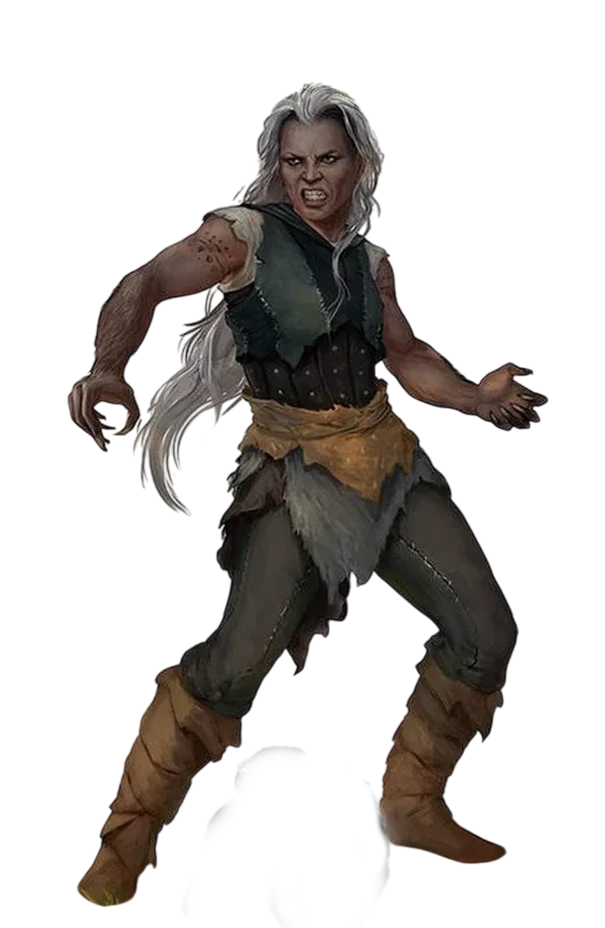
Wereborn, sometimes called weretouched or shifters, were a rare lineage of Ancientkin Smallfolk in Somnum. They could be born as the offspring of a Lycanthrope, not inheriting their parent's full Curse of Lycanthropy, or "purebred" through a male and female shifter. Occasionally, shifters could manifest to parents unaware of a relationship with lycanthropy; some scholars speculated that dormant lycanthropic bloodlines resurfaced after generations, while others suggested that contact with magical beasts, curses, or the influence of the wilds could trigger their manifestation. In most cases, no clear pattern could be observed, and even families well-versed in their lore could not predict or explain their arrival.
Physically, wereborn bore the signs of their animalistic ancestry, often carrying traits such as sharpened teeth, pointed ears, slitted pupils, or faint claws. Others exhibited more obvious characteristics, including fur, scales, or features reminiscent of wolves, cats, or other predatory creatures. Their height and weight were similar to their parental lineage; Human-like shifters generally ranged from five to seven feet tall and 120 to 240 pounds, though this varied. Wereborn matured younger than typical members of their lineage, with physical traits becoming more pronounced with age, and typically lived slightly shorter lives.
Often rejected by greater society, wereborn were rare, but formed communities that valued survival, adaptability, and connection to nature. These shifters often kept to the outskirts of Somnum’s larger societies, traveling in small hunting parties or forming loose, nomadic clans. Tribal bonds were strong, and personal prowess was respected; those who could prove themselves in hunting, tracking, or combat earned social standing. Many tribes had rites of passage that tested endurance and skill, reinforcing the principle of survival of the fittest. To outsiders, they could appear secretive or unpredictable, and in the broader society of Somnum, beastborn were regarded with curiosity, caution, or fear, particularly by those who associated them with wild animals or lycanthropes; their presence in towns and cities was uncommon and often temporary.
Wereborn communities were extremely conscientious of acts of disunity; many had personalities influenced by their particular lycanthropy. Some descended from the likes of Werewolves were more likely to display antisocial traits, particularly around the full moon. Unnecessary cruelty or betrayal was made taboo to enforce group cohesion, and effort was made to guide these members to quell their natural temperament. Some beastborn felt this lycanthropic connection to their personality as a spiritual manifestation, which they referred to as "the beast within." These members were more likely to follow religious or magical paths, seeking to understand the Bear, Wolf, or whatever animal they embodied as ancestors, guides, or even deities.
Wereborn could inherit a variety natural abilities from their animalistic ancestry, but nearly all had darkvision and some form of enhanced physical nature or sense. They could manifest bursts of heightened physical power, becoming more beast-like for a short time, which made them formidable in combat or survival situations. This shifting power was subtle, never transforming them to resemble true lycanthropes, but was plainly visible to any who witnessed it.
Wereborn spoke whatever local tongue was common in their upbringing, though tribal dialects, calls, or whistles were often passed down within clans to coordinate during hunting or convey complex meanings in the wild. Those who moved into broader societies could adapt quickly to urban speech while retaining elements of their tribal communication for secrecy or tradition.
As they had no language of their own and often lived in blended communities, names among these people reflected both lineage and personal traits. Their names typically overlapped with the names of other cultures typical in their region. Many shifters preferred to keep their personal names only for friends and family, and used "wandering names" with strangers, typically tied to a physical or personality trait. Examples of such wandering names included Badger, Swift, or Scar.
Adventurers among the wereborn were rare, as most preferred life in the wilds or within tribal communities, but some nomads found communities in other adventurers. Those who did take up Adventuring Classes often became Rangers, Rogues, or Brutes, following paths that emphasized their physical prowess and abilities in survival and tracking. Others followed the path of the "beast within" and became Druids, Martial Artists, or Clerics of the land, seeking to harness latent magical forces tied to their animalistic ancestry. Shifter adventurers who chose other paths tended to be unusual personalities, influenced by contact with other cultures or greater divine powers.