
🟩 Lawful Deities & Powers
Donblas the Justice Maker
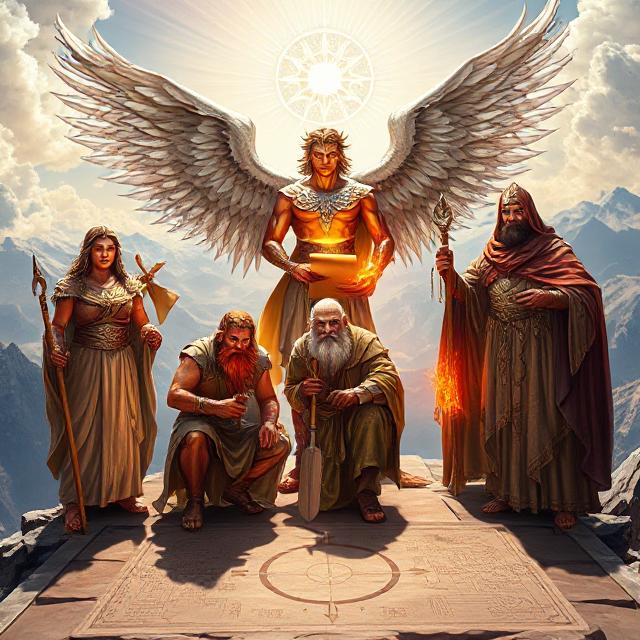
Donblas, the Justice Maker, is the radiant god of truth, law, and divine order, revered by paladins and judges alike. He stands as a shining example of moral clarity, wielding no weapon but his unwavering authority, and judging all souls with impartial balance. His followers act as arbiters, protectors, and champions of the righteous, guided by the image of the scales set within the sun.
Lughrin Worldshoulders (dwarven god)
Lughrin Worldshoulders is the dwarven god of stonecraft, architecture, and lawful creation. Revered as the divine artisan who laid the blueprints for the dwarven cities, his temples are subterranean marvels of geometry and permanence. Builders, miners, and smiths invoke his name before they measure, and his faithful see every stone laid as a sacred act of endurance.
Nisaba, the Ledger-Keeper
Nisaba is the lawful goddess of grain, writing, and honest trade, revered wherever ledgers are kept and contracts are honored. As the wife of Ky, the Nature Mother, Nisaba represents the cultivated half of the natural world—the furrowed field, the weighed bushel, and the signed covenant. Her followers include merchants, farmers, and scribes, who honor her with offerings of grain and ink. She is said to walk barefoot across the roads of civilization, her footprints leaving divine law etched in stone. Her sacred symbol, a golden scale atop a stylized road, adorns granaries, tax houses, and market temples across the land.
Oshun, the Velvet Current
Oshun is the radiant goddess of love, healing, music, and community—a divine embodiment of beauty and transformation. Dark-skinned and adorned in flowing silks, gold bangles, and brilliant colors, she dances at the crossroads of art and order, turning passion into purpose and sorrow into celebration. Where she walks, division withers: she is the bridge between old enemies, the balm upon ancestral wounds, and the voice that sings harmony into law. Brought from distant shores in a time of great spiritual famine, Oshun is said to have healed the rifts between elves and dwarves, welcomed half-orcs into the embrace of civilization, and taught even the most hardened hearts to weep with joy. Her clerics dress in flowing robes of bright saffron and white, always bearing mirrors or silver tokens, and are required to dance, sing, or play an instrument during rites—beauty, to them, is a sacred act.
St. Kanatius
St. Kanatius is the martyr-saint of miners and those who labor beneath the earth. Once a mortal who perished rescuing others from a collapsed mountain, his sacrifice elevated him to sainthood. His worshippers honor him through acts of rescue, selflessness, and perseverance in darkness, often praying beneath pick and shovel in times of danger or collapse.
St. Ras the Radiant
Once a mortal knight of unwavering duty, St. Ras was granted divine status upon his death, becoming the patron of sacred oaths, noble service, and the burdens of fidelity. His followers dedicate themselves to singular, often lifelong quests, guided by solemn visions and empowered by vows so pure they pierce the veil between mortal and divine.
Sovereign Church (Philosophical Faith)
The Sovereign Church is not a deity but a disciplined, human-centered philosophy built around the sacred flame that dwells within every soul. Believing that each person carries the divine spark of creation, its followers tend their inner fire through moral discipline and courage. Their temples are built around ever-burning hearths, and their priests teach that salvation comes from within, not from without.
🟨 Neutral Deities & Powers
Chance, Lady of the Wheel
Chance, the Lady Luck, governs fate’s fickle hand—granting fortune to some and ruin to others without malice or mercy. She is the wheel that turns without pattern, worshipped by gamblers, rogues, and hopeful fools. Her cults whisper prayers before risks, and her symbols are both feared and sought in equal measure, for she cares not who benefits—only that the dice are cast.
Corellon Larethian, the Firstborn Flame (elven god)
Corellon is the ever-shifting, ever-brilliant god of elvenkind, known as both warrior and poet, mage and muse. Though aligned with none but the elves, Corellon’s grace flows through all things beautiful, creative, and transformative. He is said to have shaped the first elves from his own blood spilled in battle against Gruumsh, and he continues to guide their pursuit of art, arcane mastery, and refined warcraft. Worship of Corellon is often private, ritualistic, and rare outside elven enclaves—but his symbol, a crescent moon enclosed in a circle, can be found carved subtly into the halls of ancient elven ruins and high spires alike.
Duke of Bones
The Duke of Bones is a minor, silent god of death’s lower tier—lord of skeletons, zombies, and the animated remnants of the once-living. Neither wholly evil nor truly merciful, he watches over the unliving as a master of bone and quiet purpose. Necromancers who animate the dead without divine aid unknowingly channel his will, and those who honor him do so by burning animal bones or leaving silent offerings in forgotten crypts. He is rarely worshipped formally, but his symbol—a skeletal hand reaching upward—is sometimes etched into graveyard stones or scratched into the doors of mausoleums where the dead do not rest easy.
Ky, the Nature Mother
Ky is the wild, untamed goddess of nature, embodiment of blooming life, rain-soaked storms, and the heartbeat of the wilderness. She cares nothing for cities or plowed fields, instead nurturing the chaotic beauty of untouched lands. Revered by druids, rangers, and beastkin, Ky is both nurturing and feral, and her wrath is as sacred as her blessings.
Math, Keeper of the Flame of Wisdom
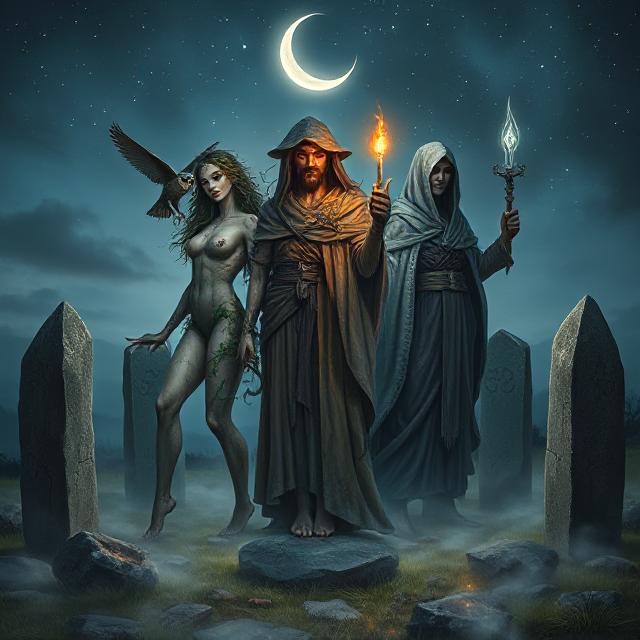
Math is the god of magic in its purest form, a flame of knowledge that flickers outside morality and within mystery. Worshipped by mages, seekers, and lorekeepers, he is said to have woven the original strands of arcane power into the cosmos. His rites are practiced during eclipses and celestial conjunctions, and his temples resemble observatories more than churches.
Samadi the Macabre Jester
Samadi, the Macabre Jester, is the patron of gallows humor, graveyard feasts, and the absurdity of mortality. Appearing as a skeletal clown or masked fool, he teaches that life is a joke with death as the punchline—and only by laughing can one survive the horror of truth. His cultists are often seen as mad or morbid, but their rituals bring strange clarity through satire and sorrow.
Straasha, the Water King Lord
Straasha is the neutral god of water in all its forms—river and rain, wave and mist—and the sovereign of all water elementals. He is worshipped as a stern but benevolent sea father by sailors, fishermen, and those who rely on the tides for survival. Straasha’s favor brings safe passage and calm waters, but his wrath can drown fleets with a gesture. He despises the corruption of the abyssal god Pyaray, and his clerics are often tasked with cleansing seas and opposing undead-tainted waters. His symbol, a cresting wave, is painted on prows and carved into harbor stones, ever watching over those who tread the shifting blue.
Vaughn, the Red-Handed Sage
Vaughn is the embodiment of war in its purest, most neutral form—neither cruel nor just, only inevitable. With blood-red hair and a dented sword, he walks battlefields both ancient and yet-to-be, honored by warriors of all alignments. He does not incite war, but welcomes it, and his faithful learn to understand conflict not as evil, but as the forge where strength is made.
Hyrn the Horned Lord
The untamed pulse of the deep wilds—the god of the hunt, of feral balance, and of the sacred silence between heartbeat and breath. Neither cruel nor gentle, he is primal necessity incarnate, brother to Ky the Nature Mother and brother-in-law to Nisaba, whose civilizing touch has earned him the wary respect of rangers and beast-bonded warriors. Hyrn strides the twilight between predator and protector, stalking poachers and slayers without honor, yet guiding hunters who take only what the land can bear. Upon death, his favored are said to join the spectral Wild Hunt, chasing through storm and moonlight until the world’s last dawn. His rites are few but fierce, celebrated with bone-carved totems, blood-oathed vows, and the howl of horns at the solstice wind. Those who glimpse his shadow in the deep woods never forget it—nor do they speak of it lightly.